The Christmas Carol That Helped Save A University

American spiritual songs are difficult to date because they were passed down orally without publishing or recording. Such was the case with the Christmas song Go,Tell It On the Mountain. It became a Christmas classic because of the efforts of John Wesley Work.

John Wesley Work was born and raised in Nashville, Tennessee. He studied Latin and history at Fisk University, but his great passion was music. In 1872, he was asked to lead the Fisk Jubilee Singers, a ten member touring vocal ensemble commissioned to save the University. In a bold move, the ensemble was sent on an eighteen month tour and was given the entire University treasury for travel expenses.

Go, Tell It On The Mountain and other spirituals were a regular part of the student singing at Fisk University, but were not part of the original repertoire of the ensemble. This is understandable because the songs were associated with slavery and represented recent history many of them wanted to forget. However, the school’s treasurer encouraged them to expose the world to the rich history of spirituals in this tour. The response was overwhelming and by the time they reached New York in December of that year, their concerts consisted primarily of choral arrangements of spirituals. 

Over the course of their 18 month tour, the Fisk Jubilee Singers grew to a full choral ensemble. Led by John Wesley Work, they performed a host of spirituals to both white and black audiences across the United States and Europe, including William Lloyd Garrison, Wendell Phillips, Ulysses S. Grant, William Gladstone, Mark Twain, Johann Strauss, and Queen Victoria. This phenomenal tour resulted in both the school and the musical style earning an international reputation. Fisk University was saved financially and Go, Tell It On the Mountain was on its way to becoming a Christmas staple.

Click here to hear Mahalia Jackson’s rendition of Go, Tell It On The Mountain. 
Click here to read more about the history of Fisk University.

The Christmas Carol With The Surprise Ending

The original author of O Come, O Come Emmanuel is unknown, but it was most likely an 8th or 9th century monk or nun. Roughly 1000 years after it was written, an Anglican priest named John Mason Neale discovered the song while reading Psalterium Cationum Catholicorum, an ancient book of Latin poetry and music. 

Neale lived in the Madeira Islands near the continent of Africa, where he started an orphanage, a school for girls, and a ministry to reclaim prostitutes. He understood many languages, including Latin, and was able to translate O Come, O Come Emmanuel into English. He first played and sang it for the people he served, who were considered the lowest of society. It was so well received that Neale included the song in his 1851 collection titled Mediaeval Hymns and Sequences.

O Come, O Come Emmanuel is written as if you are in the first century and you are awaiting the actual birth of the Messiah. An anticipation is there for what Jesus would bring. The original Latin text contains seven antiphons (verses) which work together to help the reader or singer to focus on the coming Christmas. Most modern hymnals do not include all seven and rarely in the same order as the original. Here are those verses in order and their related meanings:

  • O Sapentia (Wisdom)
  • O Adonai (Hebrew for God)
  • O Radix Jesse (Root of Jesse) 
  • O Clavis David (Key of David)
  • O Oriens (Dayspring)
  • O Rex genitium (King of the Gentiles)
  • O Emmanuel (God with Us)

You can see from the order above that the 8th and 9th century Christians sang these verses in the opposite order as most people today. Most importantly, they sang the “O Come, O Come Emmanuel” verse last and wouldn’t do so until Christmas Eve. They did this because of the fulfillment of the song and the expectation of Jesus’ birth. 

Here’s the coolest thing.

The original Latin text creates a reverse acrostic which is not complete or seen until the last verse is sung. When the ancient worshipers finally sang this verse on Christmas Eve, the message of the reverse acrostic was solved for all the see. It simply proclaimed, “I shall be with you tomorrow.”

Click here to hear For King and Country’s version of O Come, O Come Emmanuel

Click here for Anna Hawkins version in English and Hebrew filmed in Israel

*Image courtesy of Mike Ralph and Unsplash.com

The Christmas Carol written by an Atheist, composed by a Jew, and translated by a Transcendentalist.

I once attended a worship service when the congregation attempted to sing O Holy Night. At the end, the worship leader shook her head, and said, “Well, that was awful.” As hard as it can be to sing, congregations around the world love this beautiful song. It has a majestic yet mysterious sound. It is regarded as holy but acknowledges the darkness within each of us. It also has a unique story.

It was Roquemaure, in southern France, in 1843. The parish priest wanted to commemorate the renovations of the church organ, so he commissioned a poem from the local poet and wine merchant Placide Cappeau. While on an overnight stagecoach to Paris, Cappeau penned Minuit, Chretiens, or Midnight, Christians. The priest was extremely pleased with the poem, especially because the author was an outspoken atheist. However, the lyrics were so beautiful, the priest pushed forward and shared them with Adolphe Adam, a prolific Jewish composer. The resulting Christmas Carol was titled Cantique de Noel. It premiered in 1847 featuring a local opera singer Emily Laurey.

Cantique de Noel became instantly popular with Christians across France. However, once word reached the church officials that Cappeau was an atheist who publicly spoke out against the church, the song was banned from liturgical use in France. Even so, the song continued to spread outside the church and grew in popularity.

Later, in 1855, John Sullivan Dwight, an American music critic and Unitarian Minister translated the song into English. He was a Transcendentalist who believed there was goodness (and possibly holiness) in everything and everyone. His translation liberties can be seen in our current version of O Holy Night. when the evening itself is seen as holy. For Dwight, the night was holy in and of itself, not simply because of its connection to Jesus’ birth. Most people missed this completely because the chorus includes the lyric, “O Night when Christ was born.” The song then continued to grow in popularity across the English speaking and French speaking worlds. 

The song is believed to have even played a part in the Franco-Prussian War. On Christmas Eve in 1870, French troops sang Cantique de Noel from the battle trenches. In the stillness, German soldiers heard the singing and were moved. In response, they sang a carol by Martin Luther. This impromptu Christmas worship resulted in a 24 hour truce in honor of Christmas. Now, there is a strong possibility that this never happened, but the story spread across France making the song wildly popular which resulted in its eventual reinstatement in the liturgy of French churches.

So, there you have it. O Holy Night was a song commissioned to celebrate an instrument, written by an outspoken atheist, composed by a devout Jew, translated by a Transcendentalist, banned from church use in France, finally used as an instrument of peace in a time of war. Most people sing it without concern to its origin, which is probably just as well, but it does go to show you that God can work through the most unlikely of sources to create something beautiful.

Click here to hear a version of O Holy Night sung by Carrie Underwood on the Tonight Show.

*Image used courtesy of Ales Krivec and Unsplash

The Christmas Carol with the Nasty Tune

In 1865, William Chatterton Dix, a businessman in Bristol, England, became ill. His sickness caused a near death experience which left him with severe depression. During his recovery, however, Dix became an avid reader of the Bible and experienced a personal revival of sorts. His reading led to his writing of several poems, songs, and hymns, including  the beloved Christmas carol What Child Is This? For the tune of his new song, Dix chose the tune from the well known English folk song Greensleeves. 

Greensleeves was a popular English folk song probably written in the 16th century. The lyrics of the song contain numerous references to a lady in green sleeves who cheated on her beloved. Popular legends claim that King Henry VIII composed the song for his mistress then wife Anne Boleyn, but there doesn’t seem to be much historical evidence for that theory. A more likely possibiliy is that the song was written about a loose young woman, possibly a prostitute, whose dress developed green sleeves because she frequently engaged in sexual activities in the great outdoors. Greensleeves could just as well have been titled Grass Stains.  

Ewwww!

Can you imagine the looks they gave each other in church when What Child Is This? was sung for the first time in church? It would be like a modern composer setting Christian lyrics to Marvin Gaye’s Let’s Get It On. However, it’s my guess that in 1865 that no one really thought much about the meaning behind Greensleeves and were simply happy to know the tune to the new Christmas carol. 

The truth is, the tune itself is amoral. It’s neither bad or good. It’s simply music. And I, for one, am happy that the tune Greensleeves was redeemed in a way and now helps us worship Jesus.

Merry Christmas.

Click here  to hear What Child is This? performed by Take 6.
Click Here to hear a version of Greensleeves performed by Tim Foust.

Image courtesy of David Beale and Unsplash

The Christmas Carol That Isn’t About Christmas

My little sister used to love the Christmas Carol Joy To The World. When she was little, she used to sing out, “Let every heart repair His room!” I can still hear my mother crying out, “Prepare! Sing it right. Prepare Him room.”

I’ve often wondered if my little sister would have enjoyed the Christmas Carol so much if she would have realized that it actually isn’t about Christmas. The lyrics were originally written as a poem in 1719 by the English hymn-writer Isaac Watts in His collection The Psalms of David. The poem was based on Psalm 98 which is actually more reflective of Christ’s second coming than of His birth. In 1836, a Boston music teacher set Joy To The World to music and published it in December which is why it became associated with Christmas. 

I’ve heard it said that ignorance is bliss. When I first learned the truth about Joy To the World, I couldn’t sing it during the Christmas season. It bothered me to no end that the entire world was wrong about the meaning of the song. But, as I matured, I thought, “Who cares?” It’s a great song of worship that brings joy to millions of people every year. Isaac Watts would be thrilled with the success of his poem. 

If the Lord is honored by it, that’s enough for me. Besides, I love the memory of my sister singing it. She’ll have to tell me if she still likes it when she reads this post.

Click Here to listen to one of my favorite renditions of Joy to the World by Whitney Houston and the Georgia Mass Choir.

*Image courtesy of Sincerely Me and Unsplash

Great Song, Terrible Name

One of my favorite Christmas carols has a dreadful name. In fact, its name may be the reason it isn’t included in many of today’s “happy and jolly” Christmas collections. However, to me, this carol has one of the best sentiments regarding Christmas. It always moves me.

The carol to which I’m referring is In the Bleak Midwinter by Christina Georgiana Rossetti. 

Christina grew up in an artistic home and with representatives from the world of art and literature frequenting her family home. Unfortunately, Christina became ill at the age of sixteen and lived with poor health for much of the rest of her life. She faced the solitude of her sickness with a deep faith which can be seen in her writings. Not willing to let illness stop her literary contributions, Christina published three books of poetry, four devotional collections, and many Christian songs, including In the Bleak Midwinter.

With great skill, Rossetti creates a hopeless, desolate world, filled with bleakness and despair. Into this world, Jesus, Immanuel, God With Us, the Incarnate One, the Light of the World is born. Jesus transforms this world, bringing warmth and light into the most desperate of situations. Heaven’s glories couldn’t hold this Savior of ours back from bursting into our world. The humble circumstances of his birth didn’t dissuade Him from His mission of redemption. Hallelujah!

In the final stanza, the author is forced to deal with her own response to the Christ Child. What can I bring to Him or offer Him that would be of value to Him:

What can I give Him, Poor as I am?

If I were a shepherd, I would bring a lamb.

If I were a wise man, I would do my part;

Yet what I can I give him;

Give my heart.

Click here to hear the song performed by Keith and Kristyn Getty or Click here for a more liberal performance by Rend Collective 

Merry Christmas…

*Photo Courtesy of Red Dot on Unsplash

Pastor Claude Williams Was Wrong

Claude Williams

Pastor Claude Williams was wrong.

He was a loving husband, caring father, faithful pastor, and my friend, but he was very wrong.

Many years ago, before Hurricane Katrina, before Pastor Claude became Pastor Claude, we were in life group together. One night, our group gathered around a picnic table outside a local hamburger restaurant. Claudes sons, yet to be born, were mere dreams, but his love for Twila was quite real. At the time, she was serving in children’s ministry and Claude had accompanied her on several children’s ministry projects. I had seen him enjoying himself as he interacted with the kids, and I mentioned to him at the outing that he seemed to be good with kids. Claude had always been very precise and eloquent with his speech, so his humorous response took me by surprise.

He said, “I don’t know nothing about no children.”

But Claude Williams was wrong.

When I shared the news of his passing with a friend and co-worker, she said, “I ran out of gas in the middle of the road three months ago. It was Claude who showed up and pushed my car out of the street and then on to the gas station.”

Pastor Claude was always giving of himself to others, but as I think back on his response to me 15 years ago, I realize that he was still wrong.

I watched him love his wife, raise three sons, give himself to children’s ministry, youth ministry, and then care for and lead a congregation filled with the children of God.

But he was wrong. You see, Claude knew all he needed to know about children, both young and old. 

If he were here today, if he could read these words and hear me speak to him, I’d congratulate him on being a great man, thank him for being my friend, remind him of our conversation, and tell him how wrong he was.

20th Century Classic Book Impacts 21st Century Ministry

raghu-nayyar-454320-unsplash

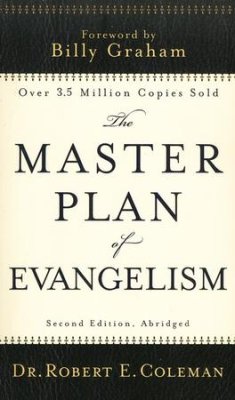
On August 29, 2005, the flood waters of Katrina destroyed my copy of Robert Coleman’s book, The Master Plan of Evangelism. Recently, I overheard a few of my younger ministry colleagues talking about how much the book had meant to them, so I found a copy and devoured it within a days. I had read it decades earlier, but don’t remember it having the same impact on me as a younger man.

Robert Coleman uses the life and ministry of Jesus as his example, demonstrating to the reader that the master plan of evangelism is really discipleship. The author, in the preface, states: “This is one of the marvels of his (Jesus’) strategy. It is so unassuming and silent that it is unnoticed by the hurried churchman. But when the realization of his controlling method finally dawns on the open mind of the disciple, he will be amazed at its simplicity and will wonder how he could have ever failed to see it before.”

I’ve heard it said that many methods of evangelism focus on people rather than on Jesus. I’m not sure if that’s true or not, but I do know that when we focus on making disciples, we keep Jesus as the center. One person even remarked to me that Robert Coleman should have titled his book The Master Plan of Discipleship. I beg to differ. I think he should have titled it The Master’s Plan of Evangelism.

Robert Coleman breaks down Jesus’ plan for world evangelization into eight parts:

  • Selection – Jesus planned to use His disciples as His method of reaching the world.
  • Association – The disciples learned from Jesus by doing life and ministry with Him.
  • Consecration – The greatest understanding of truth is learned through a life of obedience.
  • Impartation – Disciples of Jesus must have the Holy Spirit within them to follow Jesus completely.
  • Demonstration – Jesus demonstrated to His disciples His method of evangelism. He was the method and He wanted them to be as well.
  • Delegation – Disciples of Jesus must be given practical work assignments with the expectation that they be carried out.
  • Supervision – When discipling people, the leader or mentor must supervise and guide the disciple to minister as Jesus did.
  • Reproduction – Jesus expects His disciples to produce other disciples.

Sounds pretty simple, yet brilliant at the same time. Where else but from Jesus Himself can you find a plan for one on one mentoring, personal ministry and leadership development, and lifelong friendship resulting in a changed world. Simply amazing.

However, for this to work for most people, things have to change.

First, Christian leaders must be willing to invest in people rather than in programs. Jesus called people to serve Him and emulate Him. Programming is important but secondary to this investment.

Second, Christian leaders must be patient as new disciples develop into new creatures of Christ. There is no instant Christian maturity pill people can take. True Christian growth that lasts often takes years of trusting and following Jesus with guidance from other Christians.

Finally, Christian leaders must be willing to invest in others for the long haul, even if ministry positions change. It doesn’t matter if your job (or ministry calling) leads you across the country, to follow this example, you must continue to disciple your mentee as he grows into the image of Christ.

I don’t know about you, but this challenges me, a lot.

In the foreword to The Master Plan of Evangelism, Billy Graham states that “Few books have had as great an impact on the cause of world evangelization in our generation as The Master Plan of Evangelism.” Even though that statement was referring to those doing ministry in the 20th century, the book has the potential to impact us in the 21st century as well.

I highly recommend this book.

master plan of evangelism

The above is a review of: 

The Master Plan of Evangelism

Copyright 1963, 1964, 1993 by Robert E. Coleman

Revell Books, A Division of Baker Publishing

Grand Rapids, Michigan

*Opening photo courtesy of Raghu Nayyar and Unsplash


The True Yet Sad Story of the Great 4th of July Search For McDonald’s Ice Cream

6502-softserve

Over the years, whenever my wife and I want ice cream from McDonald’s, something will inevitably be wrong with the soft serve machine.  Today, the 4th of July (a day when I really wanted ice cream) proved to be no exception:

McDonald’s #1 

Me:  (Walks up to Counter) Happy 4th of July!

McDonald’s Worker #1 – What?

Me:  Happy 4th of July!

McDonald’s Worker #1 – Ok.  Can I take your order?

Me:  Yes, two ice cream cones please.

McDonald’s Worker #1 – The ice cream machine is being cleaned.

Me:  Will it be a long time?

McDonald’s Worker #1 – Yes, a very long time.

McDonald’s #2

Me:  (Pulls up to drive through speaker with hopeful wife) 

McDonald’s Worker #2  (Over intercom) Can I take your order?

Me:  Yes, two ice cream cones please.

McDonald’s Worker #2 – “Our ice cream machine ain’t working right now.”

Wife:  You’ve got to be kidding.  Let’s just give up.

Me:  Never.  This is a mission.

McDonald’s #3

Me:  (Pulls up to drive through speaker) How many is this?

Wife:  Three. 

McDonald’s Worker #3 (Over intercom) Take your order?

Me:  Yes, two ice cream cones please.

McDonald’s Worker #3 – “The soft serve machine is broken.”

Me:  Really?  This is the third McDonald’s we’ve been to in the last fifteen minutes.  Are they all on schedule to be broken today on the 4th of July?

McDonald’s Worker #3 – I don’t know.  That machine breaks down all the time.

McDonald’s #4

Me:  (Pulls up to drive through speaker) How…

Wife:  (Interrupts) Four. 

McDonald’s Worker #4 – Can I take your order?

Me:  Yes, two ice cream cones please.

(Extremely Long Pause) 

McDonald’s Worker #4 – Is that all?

Me:  Yes.  (withheld jubilation)

McDonald’s Worker #4 – “$2.16.  Pull around.”

Me:  Success.

Wife:  (Rolls her eyes)

(Hallelujah Chorus plays loudly in car)

“Man of Steel” Review

We learn in the movie trailer of Man of Steel that the “S” on Superman’s chest is really a symbol meaning “Hope” on the planet Krypton.  That came to mind as Amy Adams spoke at Spike’s Guy’s Choice Awards as Man of Steel won the award for most anticipated movie of the year.  She said, “I hope that the movie lives up to all of the anticipation.” I hoped the same thing as I bought my ticket for the movie yesterday.

Man-of-Steel-655x435

You know the story – As a boy, Clark Kent learns that he has extraordinary powers, was born on another plantet, and was adopted by his earth parents.  As a young man, he travels the world to learn more about his origins and his purpose in life.  He learns to harness his powers and becomes a symbol of “Hope” for everyone on earth.

Man of Steel does a few things really well:

  1. The story is familiar but different enough to keep your attention.
  2. The action scenes were done very well.
  3. Henry Cavill was an excellent choice for the role of Superman.

Here’s where the film is really lacking (in my opinion):

There’s way too much action and not enough story.

Come on!  It’s Superman for crying out loud.  Where was the fun?  Where was the romance (besides the lame kiss and cliché)?  Where was the humor?  For that matter, where was the dialogue?

As Tom Long of the Detroit News states, “Man of Steel packs quite a wallop. A few too many wallops, as it turns out.”

Related Posts:

5 Short Summer Movie Reviews

Oz, The Great and Powerful

Review of Warm Bodies: a paranormal, romantic, zombie, comedy, narrative film