Over the years, I’ve heard hundreds of Christmas carols and songs. I’ve sung in dozens of Christmas choirs and even directed multiple Christmas musicals. To top things off, last year I started blogging about the origins of Christmas Carols. I asked my social media friends to submit their favorite Christmas carols for me to research. When numerous people submitted The Friendly Beasts, I thought it was a joke because I was totally unfamiliar with the song. Fans of Garth Brooks, Burl Ives, Johnny Cash, and Harry Belafonte were not impressed.
The Friendly Beasts originated in 12th century France, probably by Pierre de Corbeil who was the Bishop of Sens. The melody of the donkey portion was originally sung during the Fete de l’Ane or Festival of the Donkey. Instead of focusing on the birth of Jesus, this festival actuallyfocused on the holy family’s flight to Egypt. During the Catholic mass for this festival, a donkey was often ridden or led into the church building.
Over the years, the festival shifted from the Holy family’s flight into Egypt to Joseph and Mary’s journey to Bethlehem. As time passed, The Friendly Beasts featured verses highlighting the cow, the sheep, the doves, and the camel. As Jesus is born, each of the “friendly beasts” experience a magical event where they are each able to sing about the gifts they are offering to Jesus:
The donkey gave transportation for Mary to Bethlehem
The cow gave its manger as a place for Jesus to sleep
The sheep gave their wool for a warm coat.
The doves coo the baby Jesus to sleep.
The camel carried the wise men who brought gifts to Jesus
Some connect this song to old beliefs that all animals have the gift of speech at midnight on Christmas Eve. One comment I read said, “If God gave Balaam’s donkey the ability to speak (Numbers 22), why wouldn’t he do the same to the animals of the Nativity? Exploring this would be a post (if not a research paper) of its own. I understand that the story is more legendary than biblical. But, it’s still a sweet notion to think that the animals in the stable were able to participate in honoring Jesus at his birth.
It also brings to mind Psalm 148:7-13 – Praise the Lord from the earth, you creatures of the ocean depths, fire and hail, snow and clouds, wind and weather that obey Him, mountains and all hills, fruit trees and all cedars, wild animals and all livestock, small scurrying animals and birds, kings of the earth and all people, rulers and judges of the earth, young men and young women, old men and children. Let them all praise the name of the Lord. For His name is very great; His glory towers over the earth and heaven!”
Click here to hear The Friendly Beasts by Garth Brooks and friends
One of the sweetest Christmas songs I heard as a child was Sweet Little Jesus Boy. Like many, I assumed it was a spiritual first sung by the slaves of the American South. You can imagine my surprise when I learned that the song was written in 1934 by Robert MacGimsey, a white lawyer.
MacGimsey was born in Pineville, Louisiana and grew up with black domestic help including “Aunt Becky,” his caregiver. When he was an infant and young child, Becky sang spirituals to young Robert. She and other workers in the MacGimsey home gave Robert a rich background in the gospel music of the south.
Robert MacGimsey grew to adulthood and began practicing law, but he also wrote and published songs throughout his life. No matter where Robert traveled, he never forgot his Aunt Becky and the songs she sang to him as a child. In fact, Robert focused his life’s work on making African-American folk music of the South known and accessible by the world.
Sweet Little Jesus Boy was written because of a personal experience. One Christmas Eve, MacGimsey was walking through the snowy streets of New York City. He was appalled by the number of people visiting various nightclubs who chose to celebrate Christmas by getting drunk instead of focusing on who Jesus was and why He came into the world. To Robert, Christmas was a time of worship and praise. So, he penned the lyrics to Sweet Little Jesus Boy as an apology to Jesus because, as goes the refrain, “We didn’t know who you was.”
Sweet Little Jesus Boy was written to reflect the lives of black Christians during the Civil War. Robert MacGimsey once stated that as he wrote the song, he “pictured an aging black man whose life had been full of injustice standing in the middle of a field giving his heart to Jesus in the stillness.” As you read through the lyrics below, you can almost picture this taking place.
Sweet little Jesus Boy-they made you be born in a manger.
Sweet little Holy Child-Didn’t know who You was.
Didn’t know You’d come to save us, Lord;
To take our sins away.
Our eyes was blind, we couldn’t see,
We didn’t know who You was.
Long time time ago, You was born, born in a manger low,
Sweet little Jesus Boy, the world treat You mean, Lord,
Treat me mean, too,
But that’s how things is down here-
We don’t know who You is.
You done told us how, we is a trying’!
Master, You done show’d us how, even when You was dyin’.
Just seem like we can’t do right,
Look how we treated You.
But, please, Sir, forgive us, Lord-
We didn’t know ‘twas You.
Listen to Sweet Little Jesus Boysung by Mahalia Jackson on the Ed Sullivan Show on December 18, 1960.
American spiritual songs are difficult to date because most were passed down through the generations orally without publishing or recording. Such was the case with the Christmas song Go,Tell It On the Mountain. It became a Christmas classic because of the efforts of John Wesley Work.
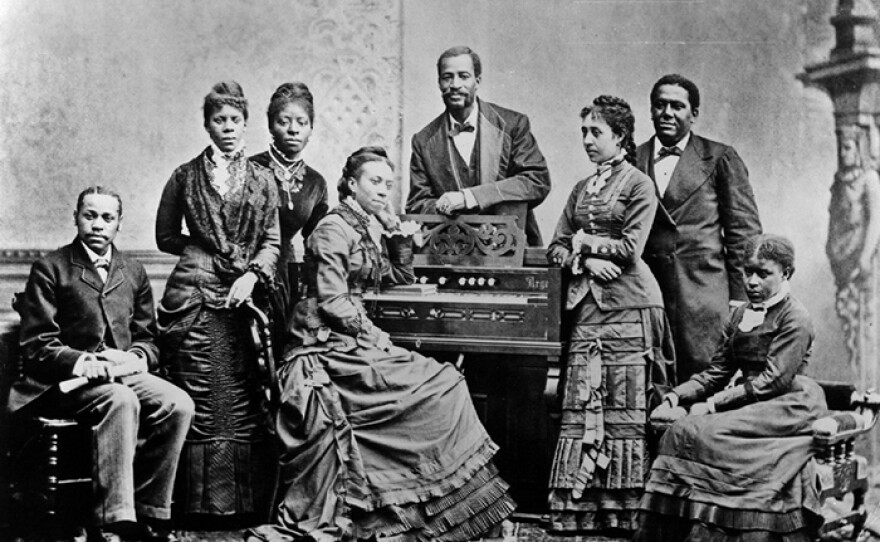
John Wesley Work was born and raised in Nashville, Tennessee. He officially studied Latin and history at Fisk University, but his other great passion was music. In 1872, he was asked to lead the Fisk Jubilee Singers, a ten member touring vocal ensemble commissioned to save the University. In a bold move, the ensemble was sent on an eighteen month tour and was given the entire University treasury for travel expenses.
Go, Tell It On The Mountain and other spiritualswere a regular part of the student singing at Fisk University, but were not part of the original repertoire of the ensemble. This is understandable because the songs were associated with slavery and represented recent history many of them wanted to forget. However, the school’s treasurer encouraged them to expose the world to the rich history of spirituals in this tour. The response was overwhelming and by the time they reached New York in December of that year, their concerts consisted primarily of choral arrangements of spirituals.
Over the course of their 18 month tour, the Fisk Jubilee Singers grew to a full choral ensemble. Led by John Wesley Work, they performed a host of spirituals to both white and black audiences across the United States and Europe, including William Lloyd Garrison, Wendell Phillips, Ulysses S. Grant, William Gladstone, Mark Twain, Johann Strauss, and Queen Victoria. This phenomenal tour resulted in both the school and the musical style earning an international reputation. Fisk University was saved financially and Go, Tell It On the Mountain was on its way to becoming a Christmas staple.
Click here to hear Mahalia Jackson’s rendition of Go, Tell It On The Mountain. Click here to read more about the history of Fisk University.
(Note: This is a repost from the 2021 Christmas Season. New Christmas Carol Stories will begin being posted daily on December 1, 2022)
There is, perhaps, no Christmas tradition more neighborly and friendly than caroling. No matter what the song, Christmas caroling spreads the true spirit of Christmas throughout December. As a child, teen, and even as an adult, I’ve sung carols like Buddy the Elf with groups in retirement centers, nursing homes, city neighborhoods, and even on country farms. However, for most of my life I had no idea how Christmas caroling actually began.
Let’s start with the carols themselves.
The original carols had their roots in the pre-Christian Festival of Yule, when Europeans would sing and dance to honor the Winter Solstice. The word “carol” has its roots in the Latin word “choraules” which means “a dance to the flute.” The original carols were mostly fun secular, upbeat songs accompanied with dances often performed with a group. Overtime, carols became more associated with Christianity and became more hymnlike and therefore resulted in less dancing (Sorry, Mariah Carey).
Christmas carols themselves thrived as more of a grassroots tradition. Saint Francis of Assisi is said to have first incorporated upbeat carols into informal (and sometimes impromptu) Christmas services in creative ways. He built nativity scenes in caves complete with live animals. The villagers would gather and listen as he taught them about the birth of Jesus. Then, they all joined in singing early versions of Christmas carols. These energetic, joyful carols were often sung with gusto, as in Celebration, in sharp contrast to the traditional somber Christmas music of the day. It’s no wonder these simple songs spread quickly across the Christian world, especially Europe.
Christmas caroling actually grew out of the Anglo-Saxon custom of wassailing, where the carolers received sustenance in exchange for their singing. This custom derives its name from the drink “wassail,” which was a hot spiced beverage. Over time, wassailing became associated with Christmas and carols. Ironically, the practice of caroling out of doors grew somewhat because of Oliver Cromwell, who banned Christmas celebrations in England from 1649 to 1660. As you can imagine, the persecution of the day most likely put a damper on the outright practice of singing carols in organized services. However, what’s to stop someone from singing Christmas Carols outdoors as they travel to and fro? Even after Cromwell’s time in power ended, caroling did not really experience growth until the 19th century, when joyful, more expressive hymns became more popular across England and Europe. During this time, some caroling groups gathered in public spaces to sing while others went from house to house. Today, the practice of Christmas caroling continues to bring joy to those singing and those hearing, with or without the wassail.
This Christmas season, from December 1st – 25th, I plan to highlight the history of 25 Christmas carols, most of which have been sung at one point or another by Christmas carolers. Some of them are currently extremely popular while others have been all but forgotten. Regardless, I’ve found them all fascinating and I plan to learn as much about them in the next month. I invite you to join me for the journey.
I love Christmas carols. Now that we’ve made it past Thanksgiving, it’s awesome that we’ll be hearing them more on the radio and tv, online, and in worship services. Last December, I posted the stories of our most beloved Christmas carols. While this year, I’ve posted more about my diet and physical fitness struggles, I plan to release posts sharing the stories of 25 more posts on December 1-25. I’ve posted links to those from last year below. If you have a favorite Christmas carol you’d like for me to research and share, post it in the comments or send me a private message. Merry Christmas!
At school. At home. At church. On tv. Even in Comic books.
No matter where I went, someone was proclaiming, “You are what you eat” like they were the one who coined the phrase.
I’ll tell you a secret.
I never believed it.
But you probably already knew that. You can look at me and tell.
So now, decades later, I hear it from my wife, health care professionals, and other mean people. Only now, they often follow the phrase with a question, “So, if you believe that phrase, then what does that make you?”
It drives me crazy when my wife asks me that question. I hold my head high, stick out my chest, and say, “Listen here, woman! I’ll be the one asking the questions around here! Now go and fix me something filled with sugar and gluten.”
I don’t really say that. I’m not stupid.
Instead, I smile sweetly and quote the food pyramid from the 1970’s: “Well Honey, I’m 4 servings of fruits and vegetables, 4 servings of grains, 3 servings of dairy, and 2 servings of meats.”
Ok, that doesn’t happen either.
Honestly, my head immediately hangs in shame, tears well up in my eyes, and I answer, “I’m a large pizza, a half gallon of ice cream, a bag of microwave popcorn, a gallon of soda, and one serving of broccoli.”
She shakes her head, takes a deep breath, and says, “John…”
“I’m sorry,” I interrupt with a smile. “Was that your broccoli?”
She has never laughed at that.
Never.
So I’m going back to the truth of the lesson I learned as a child.
I am what I eat.
My body will be made up of the foods I put into it.
If I consume healthy foods and water, I will see the benefits of eating healthy foods and drinking water.
If I eat a lot of fat, greasy food, I will become a fat, greasy dude.
This year there was a notorious prisoner, a man named Barabbas. As the crowds gathered before Pilate’s house that morning, he asked them, “Which one do you want me to release to you—Barabbas, or Jesus who is called the Messiah?” (He knew very well that the religious leaders had arrested Jesus out of envy.)… Meanwhile, the leading priests and the elders persuaded the crowd to ask for Barabbas to be released and for Jesus to be put to death.So the governor asked again, “Which of these two do you want me to release to you?” The crowd shouted back, “Barabbas!” Pilate responded, “Then what should I do with Jesus who is called the Messiah?” They shouted back, “Crucify Him!” … So Pilate released Barabbas to them. (Matthew 27:16-18, 20-22, 26a)
All of the gospel writers include Barabbas. It’s not surprising because he was a bloodthirsty murderer. Ironically, his name means “son of the father.” In a dramatic historic coincidence, his name is reported by some to have actually been “Jesus Barabbas” or “Jesus, the son of the father.” If this is true then the crowd was confronted by Pilate with choosing between Jesus, the son of the father, who rules by violence and makes his living by his wits; and Jesus, the Son of the Father, who rules by love and is ready to sacrifice Himself.
Why did they choose Barabbas? Were they somehow disappointed with Jesus?” This was the same crowd who, just a few days before, had welcomed Jesus into Jerusalem. It’s certain that some of them knew people who had experienced a healing touch from Jesus for the city was filled with people Jesus had healed. The eyes of the blind had been opened, the deaf made to hear, and the lame to walk. Jesus had awakened within people the hope that He was indeed the Messiah, come to deliver them from the yoke of Rome. But all of their thoughts of messiahship centered around the thought that He would set them free from the hated bondage of Rome. Now, when they saw Him standing helpless before the Roman governor, all their loyalty to Him collapsed. In anger and disappointment, they chose Barabbas, the son of the father.
Have you ever been disappointed in the Lord? Have you ever expected Him to act in a certain way because of what you understood about Him-but then He didn’t act as you had anticipated? God’s ways are higher than ours. We cannot figure Him out. He will always be true, faithful, truthful, but He is more than we can handle. And like the angry crowd, when He doesn’t act in accordance with our expectations, there is always a Barabbas waiting in the wings.
Prayer: Lord, Your ways are higher than my ways. Help me to hold fast to You, even when I don’t understand what You are doing.
For further clarification, yes, a full size duck hen collided with the top of my head, bounced off, then continued flying to a small body of water.
I’ve never had that happen ever.
Here’s what I learned from my experience:
First, whenever a duck flies into your head, people will laugh at you before asking if you’re ok. That’s just how life is when everyone was raised on America’s Funniest Videos.
Second, even though no one yelled “Duck!” I’m fairly certain that the expression came from a time when a duck was flying straight toward someone’s head.
Third, having thick curly hair helps with the impact when a duck crashes into your head. It helps give the duck a natural bounce. If you are bald and have plans for colliding your head with a flying duck, I would recommend a knit hat or a wig with thick curls.
Fourth, after your head makes impact with a fully grown duck, check for duck poop. Just saying.
Finally, when all is said and done, forgive the duck. Life’s too short to be holding a grudge against a duck who was just trying to get to the water when your head got in the way.
These principles help in other situations as well.
Here’s a Good Friday Service Script based around Matthew 27 that be used either live or online. This service is around 28-30 minutes long and has room for the addition of songs and a more traditional sermon. I hope you find it helpful.
Narrator: I recently spoke with a man who wanted to join our church. He said, “I like the sermons, the music, the people. The location is perfect for me and I just became a part of a friendly life group.” “Then, what’s holding you back,” I asked. “There is one problem,” he replied. “I just don’t know what to do with Jesus. I believe in God, but it seems to me that Jesus is an entirely different subject. What should I do?”
That statement, “I just don’t know what to do with Jesus” has plagued different people for thousands of years. Jesus changes things. Mention God or angels or spirituality and people will smile and nod politely. Mention the name of Jesus and people might cry tears of joy or shout curses in anger. People throughout history have often thought, “I just don’t know what to do with Jesus.”
The Roman governor Pilate was one of those people.
Jesus Before Pilate Section
(Readers stand in a line. They can either memorize their lines, read from scripts or have cameras focus on them as they read from teleprompters.)
Reader One: After His arrest, Jesus stood before Pilate, the Roman governor.
Reader Two: (speaks as if he is Pilate)Are you the king of the Jews?
Reader Three: (speaks as if he is Jesus) You have said it.
Reader Four: But when the leading priests and the elders made their accusations against him, Jesus remained silent.
Reader Two: Don’t you hear all these charges they are bringing against you?
Reader One: But Jesus made no response to any of the charges, much to the governor’s surprise. Now it was Pilate’s custom each year during the Passover celebration to release one prisoner to the crowd-anyone they wanted.
Reader Four: This year there was a notorious prisoner named Barabbas. As the crowds gathered before Pilate’s house that morning, he asked,
Reader Two: Which do you want me to release – Barabbas, or Jesus the Messiah?
Reader Four: (agitated) Just then, Pilate’s wife sent him this message: “Leave that innocent man alone. I suffered through a terrible nightmare about him last night.”
Reader One: Meanwhile, the leading priests and the elders persuaded the crowd to ask for Barabbas to be released and for Jesus to be put to death. Pilate asked again,
Reader Two: Which of these two do you want me to release to you?
Readers One, Three and Four: (shouting) Barabbas!
Reader Two: Then what should I do with Jesus?
Readers One, Three and Four:(shouting) Crucify him!
Reader Two: Why? What crime has he committed?
Readers One, Three and Four: (Shouting) Crucify him!
Reader One: Pilate saw that he wasn’t getting anywhere and that a riot was developing. So he sent for a bowl of water and washed his hands before the crowd.
(show b-roll of Pilate washing his hands in a bowl)
Reader Two: I am innocent of this man’s blood. The responsibility is yours!
Readers One, Three and Four: We’ll take the responsibility for his death.
Reader One: So Pilate released Barabbas to them. He ordered Jesus flogged with a lead-tipped whip, then turned him over to the Roman soldiers to be crucified.
(show b-roll of Jesus being tied down for the flogging)
Transition 1
Narrator: (Washes his own hands in a basin of water) Pilate washed his hands in front of the people because he wanted to claim personal innocence regarding the death of Jesus. Whether he did this for his personal convictions or to appease his wife, he sentenced “the king of the Jews” to be crucified because he didn’t know what to do with this Jesus. The soldiers, on the other hand, seemed to have no question about what to do with Jesus. They tied Jesus to a whipping post, flogged him with a lead tipped whip, and then began to mock him.
The Soldiers Mock Jesus Section
Reader One: Some of the governor’s soldiers took Jesus into their headquarters and called out the entire regiment.
Reader Two: They stripped him and put a scarlet robe on him. They wove thorn branches into a crown and put it on his head, and they placed a reed stick in his right hand as a scepter.
Reader Three: Then they knelt before him in mockery and taunted,
All: (kneel in a mocking fashion and cry out in unison)“Hail! King of the Jews!”
Reader Four: And they spit on him and grabbed the stick and struck him on the head with it.
When they were finally tired of mocking him, they took off the robe and put his own clothes on him again.
All: Then they led him away to be crucified.
Transition 2
Narrator: (Holding a small cross in his hands) It was then that our bleeding, beaten Savior was forced to carry the cross upon which he would be crucified to the place of his own crucifixion. This was done to humiliate him and to wear him down even more. The cross could have been 3 to 4 meters high with a crossbeam another two meters wide. Depending on the thickness of the beams, it could have easily weighed between 170 and 300 lbs. The winding route Jesus carried his cross would have been from the former Antonia Fortress to what is now the Church of Holy Sepulchre. That’s a distance of about 600 meters or just over one third of a mile.
The CrucifixionSection
(Crucifixion b-roll throughout)
Reader Four: Along the way, they came across a man named Simon, who was from Cyrene, and the soldiers forced him to carry Jesus’ cross. And they went out to a place called Golgotha (which means the ‘place of the skull.)
Reader Three: After they had nailed him to the cross, the soldiers gambled for his clothes by throwing dice. Then they sat around and kept guard as he hung there.
Reader One: A sign was fastened above Jesus’ head, announcing the charge against him. It read:
All: (Slightly Louder) This is Jesus, the King of the Jews.
Reader Four: Two revolutionaries were crucified with him, one on his right and one on his left. The people passing by shouted abusing and vulgar statements, shaking their heads in mockery.
Readers One: Look at you now!
Reader Two: You said you were going to destroy the Temple and rebuild it in three days.
Reader Two:Well then, if you are the Son of God, save yourself and come down from the cross!”
Reader Four: The leading priests, the teachers of the religious law, and the elders also mocked Jesus.
Reader Two: “He saved others,” they scoffed, “but he can’t save himself!
Reader Three: So he is the King of Israel, is he? Let him come down from the cross right now, and we will believe in him!
Reader One: He trusted God, so let God rescue him now if he wants him! For he said, “I am the Son of God.”
Reader Three: Even the revolutionaries who were crucified with him ridiculed him in the same way.
Transition 3
Narrator: (holding long nails in his hands)This time must have been a very confusing time. For Jesus, he had found his friends sleeping while anxiety blood tears stained the ground around him. Most had abandoned him upon his arrest. Peter had denied him. The crowds, some of whom he had taught and fed, cried out for his crucifixion. Then He was mercilessly crucified and even those being crucified with him, those dealing with the same pain as He, were mocking and ridiculing Him. They all seemed to know what to do with Jesus. And now, God the Father knew what to do as well. He was going to allow His only Son to die.
The Death of Jesus
(Cross b-roll throughout)
Reader One: (slowly, determined) At noon, darkness fell across the whole land. At three o’clock, Jesus called out with a loud voice,
Reader Three: (shouting as if Jesus on the cross)Eli, Eli, lema sabachthani? My God, my God, why have you forsaken me?
Reader Two: Some of the bystanders misunderstood and thought he was calling for the prophet Elijah.
Reader One: One of them ran and filled a sponge with sour wine, holding it up to him on a reed stick so he could drink.
Reader Four: But the rest said, “Wait! Let’s see whether Elijah comes to save him.”
Reader Three: Then Jesus shouted out again, and he released his spirit.
Reader Four: At that moment the curtain in the sanctuary of the Temple was torn in two, from top to bottom.
Reader One:The earth shook, rocks split apart, and tombs opened.
Reader Two: The bodies of many godly men and women who had died were raised from the dead.
Reader Three: They left the cemetery after Jesus’ resurrection, went into the holy city of Jerusalem, and appeared to many people.
Reader Four: The Roman officer and the soldiers at the crucifixion were terrified by the earthquake and all that had happened. They said,
Reader One: (emphasis on man)Surely this man was the Son of God!
Readers One and Two: (emphasis on was) Surely this man was the Son of God!
All: (emphasis on Son of God) Surely this man was the Son of God!
Sermon and Decision Time(time will vary based off of comments and decision time from pastor)
Pastor: What will you do with this Jesus? That does seem to be the question, doesn’t it? Will you abandon him like many of his disciples? Will you deny him like Peter? Will you condemn him like the Pharisees? Will you wash your hands of him like Pilate? Will you mock him like the soldiers? Or Will you dare to trust Him….? (continue to present Gospel and promise of resurrection)
Bill and Gloria Gaither met when they both began teaching high school In Alexandria, Indiana. Bill had a background in Gospel music and Gloria had been an English major in college. They began meeting to share ideas about songs, started dating, and were married in 1962. It wasn’t long before their careers shifted from teaching to music full-time.
However, the 1960’s were chaotic and the major shifts in morals and values was upsetting to the Gaithers. They even began to wonder if God had decided to turn the world over to its own devices. 1969 was a particularly bleak season for Bill and Gloria. The “God is Dead” philosophy was spreading across the nation, Indiana experienced an extremely hard winter, Bill was struck with a severe case of mononucleosis, and Gloria experienced some painful false accusations from within her church family. In the midst of this pain and suffering, Gloria learned that she was pregnant. Even though, they were happy, they both wondered if it was wise to bring an innocent baby into such a hard world.
In early spring of that same year, Bill’s father George was visiting Bill and Gloria and called their attention to a small blade of grass that had pushed through the layers of dirt, rock, and concrete to reach the sunlight. That blade of grass had such a strong will to live that it inspired Gloria to write a song expressing the hope that was shaped by the resurrection of Jesus. She wrote these words:
God sent His Son, they called Him Jesus; He came to love, heal, and forgive. He lived and died to buy my pardon; An empty grave is there to prove my Savior lives…
How sweet to hold a newborn baby, and feel the pride and joy he gives; But greater still, the calm assurance: This child can face uncertain days because He lives...
And then one day, I’ll cross that river. I’ll fight life’s final war with pain, But then as death gives way to victory, I’ll see the lights of glory and I’ll know He lives...
Because He lives, I can face tomorrow. Because He lives, all fear is gone. Because I know, He holds the future. And life is worth the living just because He lives.
Click here to check out a cool version of the song from Crowder, Johnnyswim, and Tori Kelly recorded for the Easter Service of Passion City Church.









 JohnJFrady.com