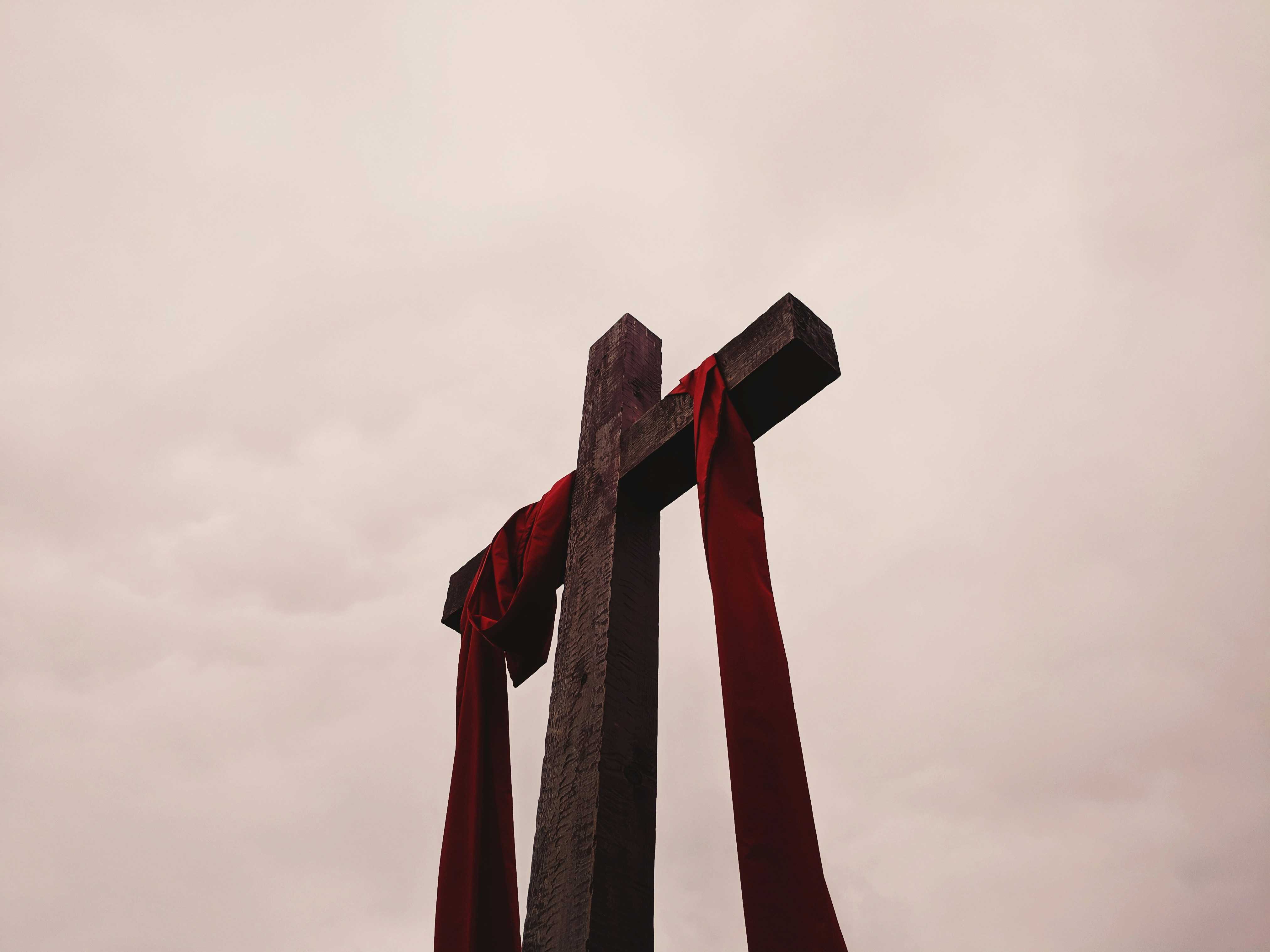
Creative Good Friday Service (2025)

This is a basic plan for the Good Friday service we’re doing at Celebration Church in New Orleans. I hope you find it useful for your church.

Items Needed 

  • Blank piece of paper (¼ sheet) for every congregation member
  • One large cross 
  • Three large nails (approximately nine inches long)
  • One oversized hammer (short, miniature sledgehammer is acceptable)
  • 1-4 regular-sized hammers for leaders to nail sins to the cross
  • Smaller nails for nailing paper to cross

Order of Worship:

  • Welcome
  • Short Giving Talk and Offering Prayer 
    • Say something brief like this – “Our ushers are preparing now to receive the offering. We’re thankful for all of those who give, whether online or here in person. Your giving makes a difference. It’s Good Friday, the day we remember what Jesus did for us on the cross. He gave His life for us not because we’ve earned or deserved it but because He loves us. The Lord gave so freely to us that it’s easy to give back to Him and that’s what we’re doing now before we continue with the rest of the service. You can give using the offering envelopes or online at celebrationchurch.org. Let’s pray and then we’ll receive the offering.”
  • The Two Gardens Video – (During the Video, offering is taken and the cross is placed center stage.)

Good Friday Sermon

  • Spoken transition – Say something like, “Jesus said, “Not my will, but Yours be done.” His sacrifice on the cross was unprecedented in its selflessness, embodying a love that transcends human understanding by willingly taking on the sins of all humanity. This profound act of grace offered redemption and hope, transforming the narrative of sin and separation from God into one of reconciliation and eternal life. Through His death and resurrection, Jesus redefined the concept of sacrifice, establishing a new covenant that continues to inspire and change lives across generations. Simply put, He died so that we might live. This week, we’ve followed Jesus on a journey from His triumphal entry to His cleansing of the temple. From His disagreements with the Pharisees to His anointing at Bethany. We’ve reflected on how He washed the feet of His disciples only to have one of them betray Him. He was arrested, tried, and condemned to death. Tonight, we’re going to reflect on His crucifixion and the bloody price He paid for us. 
  • THE MOCKING – The Bible says, “The soldiers took Jesus into the courtyard of the governor’s headquarters and called out the entire regiment. They dressed Him in a purple robe, and they wove thorn branches into a crown and put it on His head. Then they saluted Him and taunted, “Hail! King of the Jews!” And they struck Him on the head with a reed stick, spit on Him, and dropped to their knees in mock worship.” (Mark 15:16-19)
  • Beyond the physical pain of the crown of thorns and their blows, further humiliation was heaped on Jesus as the soldiers dropped to their knees in “mock worship.” 
  • Psalm 95:6 says, “Come, let us worship and bow down. Let us kneel before the Lord our maker.” This is not what the soldiers were doing. Instead, they were mocking the Lord and the worship of Him. Worship is serious business to God, and He doesn’t like it when people take it lightly or make fun of it.
  • Before we judge the soldiers too harshly, let’s take a minute and consider when we’ve come before the Lord with a lack of sincerity in our hearts. Have we possibly grown so accustomed to approaching His throne with boldness that we now approach it with apathy? 
  • Before we move on, take a moment and ask the Lord to forgive you for when you’ve been guilty of your own form of mock worship.
  • THE CROSS (Have volunteers stand the cross up or lift it up where people can see it. You may have to lean it against the wall or the stage.)
  • “When they were finally tired of mocking Him, they took off the purple robe and put His own clothes on Him again. Then they led Him away to be crucified. A passerby named Simon, who was from Cyrene, was coming in from the countryside just then, and the soldiers forced him to carry Jesus’ cross. And they brought Jesus to a place called Golgotha, which means ‘place of the skull.’” (Mark 15:19-22) 
  • The Cross Was Large and Heavy – After His terrible beating, the weight of the cross must have been too much for Jesus because Simon of Cyrene had to help Him. It’s believed that the cross probably weighed around 165 lbs and was most likely eight to twelve feet high with a cross beam about six feet wide. Little is known about what type of tree Jesus was crucified on. Some legends say it was the dogwood tree, but this is doubtful. The fact is, it doesn’t really matter what type of tree the cross was made from. What matters is what happened on that cross. (Expound if needed)
  • We Don’t Worship the Cross. It was simply the instrument of death where Jesus was crucified. But we do worship the One who hung on that cross. The One who gave His life for us on the cross has transformed a symbol of death into a symbol of Divine Love. 
  • THE NAILS  – Then, the unthinkable happened. We read in the Bible “The soldiers nailed Him to the cross…” (Mark 15:24)
  • (Take the three nails and drive them into the cross where His hands and feet would have been – The point is to make noise with the hammer and nails. You can combine the hammering with the sharing of the next part if you want.)
  • The Nails Were Painful – The soldiers actually took each of His hands and physically nailed them to the cross, maybe through His wrists so He wouldn’t pull away. Then, they did the same thing to each of His feet. The pain of the nails going through His body and the blood pouring from these wounds were amplified by the weight of His body pulling against the nails. (Expound if necessary)
  • The Nails are Symbols of both Sin and Redemption – They represent the gravity of our sins, serving as a stark reminder of the pain and suffering caused by our disobedience. Yet, they also symbolize redemption, as Jesus willingly endured this torment to atone for our transgressions. We should all just take a minute and say, “Thank you, Jesus.”
  • Activity(Have the people reflect on their own sins for which Jesus was crucified. Then, have them write them out on the pieces of paper they were given in their bulletin shells upon entering.) – Note: Have the people hold on to their papers after writing. We will use them again later in the service.
  • Pray and thank the Lord for the pain and suffering He endured for our redemption
  • HIS DEATH – The Bible continues, “It was nine o’clock in the morning when they crucified Him… At noon, darkness fell across the whole land until three o’clock. Then, Jesus called out with a loud voice, ‘Eloi, Eloi, lema sabachthani?’ which means ‘My God, my God, why have You forsaken Me?’ Then Jesus uttered another loud cry and breathed His last. And the curtain in the sanctuary of the Temple was torn in two, from top to bottom. When the Roman officer who stood facing Him saw how He had died, he exclaimed, ‘This man truly was the Son of God!’” (Mark 15:25, 33-39)
  • In the same moment when the Jewish leaders were rejoicing in the death of Jesus, this Roman centurion proclaimed with reverence the glory of Jesus. He proclaimed that Jesus was the Son of God, which drives home the words of Jesus to Nicodemus earlier in His ministry. He said, “For this is how God loved the world: He gave His one and only Son, so that everyone who believes in Him will not perish but have eternal life.” (John 3:16)
  • What This Means For Us – “You were dead because of your sins and because your sinful nature was not yet cut away. Then God made you alive with Christ, for He forgave all our sins. He canceled the record of the charges against us and took it away by nailing it to the cross. (Colossians 2:13-14)
  • Through Jesus, we have redemption as we release our sins to Him.
  • Share a Personal or Shared Testimony/Gospel Presentation
  • Ask the following Question: What sins do you need to release to Jesus tonight?
  • Decision Response Activity – (Have the people bring their papers on which they wrote their sins and bring them forward to leaders to nail them to the cross while also picking up their bread and juice for communion)
  • Lead the people through Communion
  • Closing

* Photo courtesy of Alicia Quan

“Like”

Are you ever confused by the texting “like” function?

I am.  

Sometimes it means the text is “liked” but often it is just an acknowledgement of what has been sent. 

A few months ago, I texted “I think I have Covid” to a friend (or former friend). He clicked like. 

😑 I guess I should be glad he didn’t click “love” which is a thing now.

I guess someone “loves” a text if they either truly “love” it, really “like” it, “like” it more than a regular “like,” or are overly emotional in general about acknowledging text messages.

Both “like” and “love” functions do quickly express emotions. However, if we’re all honest here, sometimes a “like” is just a short, curt answer meaning, “Ok, thanks, now shut up?”

“Likes” seem to have become a thing on social media. Society, even pastors and church leaders, seem bound by the approval generated by “likes.” On Facebook, the “like” is a thumbs up, on Instagram and TikTok, it’s a heart. Maybe it should be called “Insecuritygram.” 

My love language is “Words of Affirmation.” I admit that I smile when I see my posts being “liked,” especially by lots of people. I love seeing hearts and thumbs up emojis. Just like the rest of the world, I post and then check my posts to see how many people “like” what I’ve said. On the outside, I’m nodding my approval of their approval of my words. On the inside, I’m screaming, “They like me, they really, really like me!”

What we often don’t realize is that chasing after “likes” can be so devastating to our own self worth. We don’t realize that we’re setting ourselves up to be disappointed. 

Louie Giglio writes, “If we live for people’s approval, we will die by their rejection.” 

I think he’s right. If it would have been a social media post or text, I would have liked it. 

👍❤️

*Image courtesy of Jackson Sophat

Night of Worship Outline based on Ephesians 3:14-21

Opening Worship Set and Prayer

  • Song
  • Song
  • Prayer – Inviting the presence of the Holy Spirit to lead us as we worship together 

Empowering Section (When we pray, God empowers us through His Holy Spirit)

  • Song – Holy Spirit, You Are Welcome Here  
  • Scripture and Sharing – “When I think of all this, I fall to my knees and pray to the Father, the Creator of everything in heaven and on earth. I pray that from His glorious, unlimited resources He will empower you with inner strength through His Spirit.” (Ephesians 3:14-16)
  • Prayer – Asking God to continue empowering us through His Holy Spirit

Understanding Section (When we pray, God gives us glimpses of His infinite love)

  • Song – How He Loves, Reckless Love, Goodness of God
  • Scripture – “Then Christ will make His home in your hearts as you trust in Him. Your roots will grow down into God’s love and keep you strong. And may you have the power to understand, as all God’s people should, how wide, how long, how high, and how deep His love is.” (Ephesians 3:17-18)
  • Prayer – Asking God to help us understand His love for us and for the world.

Experiencing Section (When we pray, we experience the love of Jesus and the power of God in our lives)

  • Song – Same God
    • Scripture – “May you experience the love of Christ, though it is too great to understand fully. Then you will be made complete with all the fullness of life and power that comes from God”. (Ephesians 3:19)
  • Prayer – Asking God to allow us to experience His love and power.

Accomplishing Section (When we pray, God allows us to see Him accomplish more than we can ever imagine)

  • Song – I Speak Jesus
  • Scripture – “Now all glory to God, who is able, through His mighty power at work within us, to accomplish infinitely more than we might ask or think. Glory to Him in the church and in Christ Jesus through all generations forever and ever! Amen.” (Ephesians 3:20-21)
  • Prayer – Asking God to continue to accomplish more than we can ask or think in our lives, our families, our church, and our country. 

Closing – Encourage the people to keep on praying because God can do miracles. 

Upbeat Closing Song

*Photo courtesy of Ben White

My Mama Told Me: A Proverbs 31 Sermon

Recently, I had the opportunity to build out a sermon based on Proverbs 31. I’ll post it below. I hope you find it helpful.

MY MAMA TOLD ME (MAMA’S WISDOM)

Proverbs 31:1-31

  • Proverbs 31 is often held up as a standard for Christian women.
  • “The sayings of King Lemuel contain this message, which his mother taught him.” (Proverbs 31:1)
  • Most of Proverbs is attributed to King Solomon, but Proverbs 31 was based on the sayings of King Lemuel, which were originally spoken to him by his mother.
  • A “wise man” heeds the words of his Mother.
  • What lessons can Men, Women, and Children learn from the sayings of King Lemuel’s mother that are helpful for us today?

Proverbs 31 Helps Us Understand the: ACTIONS OF A GODLY MAN

  • What are some of the actions of a Godly Man?
  • Proverbs 31 tells us that a Godly Man Searches for a Godly Wife.
    • “O my son, O son of my womb, O son of my vows, do not waste your strength on women, on those who ruin kings.” (Proverbs 31:2-3)
    • “Who can find a virtuous and capable wife? She is more precious than rubies. Her husband can trust her, and she will greatly enrich his life.” (Proverbs 31:10-11)
    • “Her husband praises her: ‘There are many virtuous and capable women in the world, but you surpass them all! (Proverbs 31:28-29)
  • Proverbs 31 tells us that a Godly Man Lives a Godly Life.
    • Living a godly life includes avoiding intoxication. 
    • “It is not for kings, O Lemuel, to guzzle wine. Rulers should not crave alcohol. For if they drink, they may forget the law and not give justice to the oppressed. (Proverbs 31:4-5)
    • “Don’t be drunk with wine, because that will ruin your life. Instead, be filled with the Holy Spirit.” (Ephesians 5:18)
    • Living a godly life means developing a good reputation.
    • “Her husband is well known at the city gates, where he sits with other civic leaders.” (Proverbs 31:23)
    • Sitting at the city gates in Biblical times meant you were a leader, a decision maker, an influential man, and an administrator of justice. 
    • Living a godly life means supporting justice for the poor and oppressed.
    • “Speak up for those who cannot speak for themselves; ensure justice for those being crushed. Yes, speak up for the poor and helpless, and see that they get justice.” (Proverbs 31:8-9) 
    • Jesus – “The Spirit of the Lord is upon Me, for He has anointed Me to bring Good News to the poor. He has sent Me to proclaim that captives will be released, that the blind will see, that the oppressed will be set free…” (Luke 4:18)

Proverbs 31 Helps Us Understand The: ACTIONS OF A GODLY WOMAN

  • What are some of the actions of a Godly Woman?
  • A Godly Woman is Virtuous.
    • “Who can find a virtuous and capable wife? She is more precious than rubies.” (Proverbs 31:10)
    • “Her husband can trust her, and she will greatly enrich his life. She brings him good, not harm, all the days of her life.” (Proverbs 31:11-12) 
  • A Godly Woman is Industrious
    • “She finds wool and flax and busily spins it. She is like a merchant’s ship, bringing her food from afar. She gets up before dawn to prepare breakfast for her household and plan the day’s work for her servant girls. She goes to inspect a field and buys it; with her earnings she plants a vineyard. She is energetic and strong, a hard worker. She makes sure her dealings are profitable; her lamp burns late into the night. (Proverbs 31:13-18)
  • A Godly Woman Provides for her Family and Cares for Others.
    • “She extends a helping hand to the poor and opens her arms to the needy. She has no fear of winter for her household, for everyone has warm clothes.” (Proverbs 31:20-21) 
  • A Godly Woman is Spiritually Mature
    • “She is clothed with strength and dignity, and she laughs without fear of the future. When she speaks, her words are wise, and she gives instructions with kindness.” (Proverbs 31:25-26)
    • A godly woman is strong and courageous, filled with integrity, and always dignified. She is filled with faith in the Lord and is not anxious about what’s to come. Wisdom and kindness permeate her words and actions. 

Proverbs 31 Helps Us Understand the: ACTIONS OF GODLY CHILDREN

  • What are some of the actions of Godly Children?
  • Godly Children Bless Their Mothers.
    • “Her children stand and bless her.” (Proverbs 31:28)
    • “Honor your father and mother. Then you will live a long, full life in the land the Lord your God is giving you.” (Exodus 20:12)
    • Jesus set a great example by showing respect for His mother from the cross.
    • “When Jesus saw His mother standing there beside the disciple He loved, He said to her, ‘Dear woman, here is your son.’ And He said to this disciple, ‘Here is your mother.’ And from then on this disciple took her into his home.” (John 19:26-27)
  • Godly Children Honor All Godly Women.
    • “Charm is deceptive, and beauty does not last; but a woman who fears the Lord will be greatly praised.” (Proverbs 31:30)
    • “Reward her for all she has done. Let her deeds publicly declare her praise.” (Proverbs 31:31)
    • Proverbs 31 women are worthy of the rewards they receive.
  • The Lord expects us all to respect and honor the godly women in our lives.
  • Who are the godly women in my life I can honor today?

*Image courtesy of Luemen Rutkowski

Good Friday Service Outline – The Seven Last Words of Christ

THE SEVEN LAST WORDS OF CHRIST – 2024 GOOD FRIDAY SERVICE OUTLINE

OPENING

  • Welcome
  • Suggested Song – “The Lion and the Lamb”
  • Suggested Song – “Hallelujah For the Cross”
  • Communion
  • Song (Repeated or new)

Offering and Transition

  • Offering Intro and Prayer
  • “This is the Cross” video from Hyper Pixels Media available at this link

Transition into the Seven Last Words of Christ

INTRO: Tonight, we remember the cross. In John 3:16, when Jesus said those words, “For God so loved the world, that He gave His only begotten Son, that whosoever believeth in Him should not perish, but have everlasting life,” He knew the price He was going to pay in order to fulfill that scripture. So tonight, before we rush into the celebration of the resurrection part of Easter, we need to remember what Christ did for us on the cross. Until we understand the significance of Good Friday, we can’t fully appreciate Easter Sunday. So tonight, we’re going to remember the final words Jesus spoke before His death so we can gain that full appreciation. You can follow along with us in your special insert in your worship guide. 

FIRST WORD – FORGIVENESS

  • Spoken – We read in Luke 23 that the Roman soldiers took Jesus to Calvary, the place of the skull, and there they nailed Him to a cross and lifted Him up for all to see. These were strong men performing their duty, but I’m sure they weren’t concerned with being respectful to Jesus, the Son of God. But Jesus’ reaction to the soldiers was the first of His seven last words. He said, “Father, forgive them, for they don’t know what they are doing.” (Luke 23:34) 
  • Prayer Activity – Jesus offered forgiveness to the very soldiers who took His life. Through His death, He offers forgiveness to us as well if we will repent of our sins. The Apostle John writes, “If we confess our sins, He is faithful and just to forgive us of our sins and to cleanse us from all unrighteousness.” Take a moment and ask the Lord to remind you of sins of which you need to ask Him for forgiveness. Once they come to mind, pray and ask His forgiveness. (Give them a moment to pray, then lead them in prayer of forgiveness).

SECOND WORD – SALVATION

  • Spoken – Jesus was crucified between two thieves. One of them scoffed at Jesus, saying “So You’re the Messiah, are you? Prove it by saving Yourself – and us, too, while You’re at it. But the other criminal protested, “Don’t you fear God even when you have been sentenced to die? We deserve to die for our crimes, but this man hasn’t done anything wrong.” Then he said, “Jesus, remember me when you come into Your Kingdom.”
  • Spoken – Then Jesus said the second of His seven last words. To the repentant thief, He said, “I assure you, today you will be with Me in paradise.” (Luke 23:43)
  • PRAYER ACTIVITY – Many of us rejoice when we think about how Jesus can give us access to Heaven. However, many of us also think about those people we know who we long to be in Heaven with us. Take a few seconds and think about those people you want to see in Heaven. (Give them a moment to do so)
  • In your worship guide (or on a piece of paper), write the names of those you know who you desire to see in Heaven. (Give them a moment to do so) Now, pray for each of them. (Give them time to pray then lead in prayer, asking the Lord to draw these people to Himself so they can be with us and Him in Heaven.)

THIRD WORD – RELATIONSHIP

  • Spoken – Even as Jesus was suffering on the cross, He was concerned for the needs of others. He forgave the soldiers, offered salvation to one of the thieves, but then, He saw His mother standing beside the disciple John. He had compassion for her. 
  • Action/Spoken – The third of Jesus’ seven last words was spoken to His mother Mary and to His disciple John. To Mary, Jesus said, “Dear woman, here is your son.” And to John He said, “Here is your mother.” (John 19:26-27)
  • Action/Spoken – The Bible tells us that “From then on this disciple took her into his home.” (John 19:27). Apparently, a cherished bond developed between Mary and John, in a similar way as if John had been her son. Just as Jesus showed love for His mother and His friend, He also shows love for us by helping us establish lifelong relationships with those who will help us through this life. Take a moment and thank the Lord for the cherished friends and family He has surrounded you with. You can write their names in your insert.
  • (After a moment, lead the people in prayer, thanking God for our family/friends/church)

FOURTH WORD – DISTRESS

  • Spoken – The fourth of Jesus’ seven last words reminds us of His humanity. We read in John 19:28 Jesus knew that His mission was now finished, and to fulfill Scripture, He said, “I am thirsty.” 
  • Action/Spoken – Jesus truly suffered during the crucifixion. He was thirsty. He felt every lash, every thorn, and every nail. He endured it all because of our sin. An older Christian song asked the question, “Does He still feel the nails every time I fail? Can He hear the crowd cry “crucify” again. Am I causing Him pain? Then I know I’ve got to change. I just can’t stand the thought of hurting Him.” 
  • Jesus went through physical distress because of our sin. Romans 5:8 says, But God demonstrates His love for us in this: while we were still sinners, Christ died for us.” He shed His blood for You and for me. Let’s stand together. Remember this and thank Him as we sing.

SUGGESTED SONG – Thank You, Jesus, for the Blood Applied

FIFTH WORD – ABANDONMENT

  • (Direct everyone to be seated)
  • Spoken – The fifth of the seven last words of Christ is Abandonment. In the Gospel of Mark, we read At noon, darkness fell across the whole land until three o’clock. Then… Jesus called out with a loud voice, “Eloi, Eloi, lema sabachthani?” which means “My God, my God, why have you forsaken Me?” (Mark 15:33-34). Many of us at one time or another may have felt abandoned in one way or another. We may have felt forsaken. We may have felt like crying out to the Lord using those words of Jesus. 
  • Engagement 
    • If you would say that phrase of Jesus with me starting with “My God, My God” Say – “My God, my God, why have You forsaken Me?” 
    • Say it again – “My God, my God, why have You forsaken Me?” 
    • Say it one more time – “My God, my God, why have You forsaken Me?” 
  • Action/Spoken – Saying those words out loud helps us realize the abandonment Jesus must have felt when he was temporarily separated from His Father. Imagine Him crying out to God the Father from the cross. He must have felt so alone when “God made Him who had no sin to be sin for us, so that in Him we might become the righteousness of God.” (2 Corinthians 5:21)
  • PRAYER – (Lead the people in a pastoral prayer, emphasizing our thankfulness to Jesus for the abandonment He must have endured while on the cross.)

SIXTH WORD – TRIUMPH

Object Needed – Slightly torn swatch of material representing the Temple curtain before the Holy of Holies

  • Spoken – The sixth of the seven last words Jesus spoke before His death was It is finished.” (John 19:30) Even though it is a sad moment because Jesus is about to die. A word that is synonymous with this phrase, in Jesus’ case, is Triumph. 
  • Action/Spoken (Pick up the material). This swatch of curtain material is symbolic of the curtain in the temple in Jesus’ day. It separated the people from the Holy of holies. Matthew 27:51 reports that when Jesus breathed His last, “the curtain in the sanctuary of the Temple was torn in two, from top to bottom.” (Tear the material into two pieces) This symbolized the division between God and humanity being removed, signifying the completion of Jesus’ redemptive work and the direct access to God made possible through His sacrifice. 
  • Prayer – Take a moment to thank Jesus for finishing His redemptive work for us on the cross. Surrender Yourself to live in obedience to His will. (Allow them to pray silently for a moment, then lead them in prayer)

SEVENTH WORD – RELEASE

  • Spoken – Finally, Jesus said, “Into Your hands I commend my Spirit.” It is a bittersweet moment because, although it was sad because of His death, it was also said in anticipation of His Reunion with His heavenly Father. (Luke 23:46)  
  • PRAYER ACTIVITY – Jesus released His Spirit to His Heavenly Father. This is a good example for us all. We all have things we’re holding back from the Lord, things we should be releasing to Him today. Right where you are, bow your heads and ask the Lord, “Who or what do I need to release to You today? Then, pray and ask God to help you release those people or items to Him.” (Give them a moment to do this)
  • Now, in your worship guide is a separate blank sheet of paper. On it, go ahead and write out the people or things you need to release to the Lord today. As you finish, bring them to the foot of the cross, symbolizing that you are surrendering them to Him on this Good Friday. 
  • Action – (Give time for people to do this. The way it is done at each campus will need to be determined because of traffic flow and space. 
  • (Prayer of Thanksgiving transitioning to a Salvation and Rededication DECISION prayer) – (AFTER everyone has brought up their items, say a Pastor led Prayer thanking God for receiving all of these items we’ve released to Him and asking Him to help us remember as well. THEN transition into a decision time focusing on Salvation and Rededication in your own words)

CULMINATION 

  • Spoken – Jesus commending His spirit was the sweet part, but Him breathing His last was the bitter part, especially for those around Him. We look at what He went through and remember the rest of the story, but those who were with Him at the time could only understand that Jesus was dead. Their Lord, their Messiah, had departed this life. We’ve remembered the seven last words of Christ tonight. Now, let’s remember what happened next as we sing. 

Celebration Song – O Praise The Name or Forever

CLOSING 

  • Communication Cards/Giveaways
  • Share remaining Easter Service times/Challenge people to bring others

Production Notes 

  • This service was created for the 2024 Good Friday Services at Celebration Church in New Orleans. Please forgive any church specific references you might see.
  • We created an insert using the image at the top of this blog post as the entire inside of our worship guide. Kudos of Brenda Miranda from our staff for the drawing and for our marketing/communications department for working it into the service materials.
  • We used a piece of purple material to represent the curtain in the temple that was torn in two during the Sixth Word.
  • We also added a small piece of blank paper (1/4 sheet) for the exercise during the Seventh Word
  • A cross at the front is best. If a large cross is not available, a smaller version is sufficient.
  • Have a keyboardist or guitarist play behind the presentations for effect.

Jesus Numbers – Good Friday/Easter

2000 Years Ago

1 Savior

1 Betrayal

1 Ear Restored

1 Arrest

12 Disciples Run

1 Trial

1 Whipping Post

1 Lead Tipped Whip

39 Lashes

1 Crown of Thorns

1 Cross

1 Hill

3 Nails

5 Wounds

2 Thieves

1 Robe

6 Hours

7 Sayings

1 Mourning Mother

1 Ripped Curtain 

1 Borrowed Tomb

75 lbs of myrrh and aloes

3 Days Dead

1 Stone 

1 Seal 

2 Guards

2 White Robed Angels

0 Bodies in the Tomb

*Image courtesy of Vaishakh Pillai

St. Patrick’s Story

On March 25, 433, St. Patrick stepped onto the shores of Slane, Ireland and immediately gave a speech, which went something like this:

“Good people of the Emerald Isle! Henceforth on March 17th, or upon the weekend closest to that date, the rivers of at least one major city should be dyed green in my honor. People without the knowledge that the 3 leafed shamrock represents the Holy Trinity should wear them proudly, along with shiny green top hats. Many people will skip church in order to attend parades where green beads and cabbages will be thrown to the massive crowds who have gathered to celebrate the anniversary of my death. And children not wearing green shall be pinched unmercilessly. Ok, that’s it. Where’s the Guinness? Let’s all get sloshed!”

Ok, so it didn’t happen quite like that. 

When St. Patrick was simply Patrick, he grew up in Banna Venta Berniae, which was in the west of Britain in present day Wales. While Romanized, his family was most likely Welsh. Sixteen year old Patrick was sixteen when he was kidnapped by pirates. He was taken to Ireland and sold into slavery in Ireland where he was forced to serve as a shepherd and caretaker of animals. During his six years of captivity, he gave his life to Jesus. He also learned the Gaelic language of the people and the customs of Ireland.

Years later, he escaped and returned to his family in England, where he began preparing for the priesthood. In Confessio, Patrick’s autobiography, he writes about a dream in which he heard the collective voice of the Irish people compelling him, “We beg you, holy boy, to come and walk among us again.” So, much to the chagrin of his parents, Patrick returned to Ireland in 433 and set about sharing the gospel with everyone he met. Legend has it that Patrick used the shamrock to explain the Trinity to the local people, who had previously worshiped multiple gods.

Before Easter Sunday 433, the local Irish king, Logaire, issued a decree that no one may light any flame until the fires of a pagan spring festival were lit. Patrick, refusing to honor anyone but Jesus, lit the Easter candles anyway on the Hill of Slane. When the king heard about the devotion Patrick held to God, he was so impressed that he allowed him to continue his missionary work. 

St. Patrick lived the life of a missionary and converted thousands, planting churches across the entire island and training priests and overseers to lead them. Even though he was very well known, he lived most of his life in poverty, passing away on March 17, 461.

  • 300 years after St. Patrick’s death, Dallan Forgaill, an 8th century monk and poet, wrote the Gaelic poem “Rop tu mo Baile” honoring his devotion and unwavering commitment to God. 
  • In 1905, 1200 after it was penned, Mary E. Byrne, a university student, found a copy of the poem and translated it into English. 
  • In 1912, Eleanor Hull, an Irish woman, set the words of the translated poem to music. She chose the Irish tune SLANE because it was composed in honor of St. Patrick.
  • In 1919, the song was introduced to the world in its first hymnal and gained instant popularity. 
  • In 2019, hymnologists celebrated the 100th anniversary of the modern version of the hymn now known as Be Thou My Vision. 
  • This morning, I listened to a recorded version of the song and thanked the Lord for the devotion of St. Patrick.  Click here to check out this version by Shane and Shane.

May we all seek to obtain such a dynamic faith and undying devotion to the Lord as was displayed by St. Patrick. 
*Image courtesy of Timothy Dykes

Surely Goodness

In Psalm 23, King David writes: “The Lord is my shepherd. I have everything I need. He gives me rest in green pastures. He leads me to calm water. He gives me new strength. For the good of His name, He leads me on paths that are right. Even if I walk through a very dark valley, I will not be afraid because You are with me. Your rod and Your shepherd’s staff comfort me. You prepare a meal for me in front of my enemies. You pour oil of blessing on my head. You give me more than I can hold. Surely Your goodness and love will be with me all my life. And I will live in the house of the Lord forever.” Psalm 23, ICB

I believe and embrace that scripture with all of my heart, but I don’t feel it today. Today, I feel as if I’m far away from the rest of the green pastures and from that goodness and love.

But it doesn’t matter how I feel right now. I choose to believe the Lord.

Psalm 23 does more than tell us that God protects, guides, and blesses. Instead, like any good story, it shows us instead the image of who we truly are – a powerless sheep stranded in a world of dangerous ditches and ravenous wolves. Psalm 23 shows us that we need a shepherd.

We need the Good Shepherd – Jesus Christ. He is the only one who can truly bring us to that everlasting goodness and love.

*Image by Javardh

Rockstar?

I was in high school when I first heard Twisted Sister’s I Wanna Rock. It brought images of Dee Snyder, Eddie Van Halen, and Quiet Riot. As many times as I heard the song, I never thought of Dolly Parton. 

Dolly Parton, the country singer, composer, author, actress, and theme park owner, has recently released her long awaited album titled Rockstar. Back in 2022, Parton was nominated for induction into the Rock and Roll Hall of Fame. She almost declined because she had never recorded rock music. Fortunately, she accepted and promised to release a collection of rock songs. 

Recently, that collection, aptly named Rockstar, was released. I listened to the entire Deluxe album over the past three days, which is saying something because the deluxe edition on Spotify includes 39 songs and is just three minutes shy of being three hours long. 

Several years ago, Dolly Parton blew me away when I visited Dollywood. I was expecting it to be hokey. Instead, it was awesome. The same is true of Rockstar.

Dolly has a few original songs on the album including World On Fire (click here to listen). The song has a strong beat, great guitar lines, and strong lyrics (Leave it to Dolly to sing about God in one verse and a politician’s derriere in the next). Dolly also partners with some iconic rock stars including Sting, Steve Perry, John Fogarty, Kid Rock, Steven Tyler, Stevie Nicks, Peter Frampton, Joan Jett, Chris Stapleton, Pink, Brandi Carlile, Kevin Cronin, Elton John, Melissa Etheridge, Rob Halford, Simon Le Bon, Linda Perry, Emmylou Harris, Sheryl Crow, Pat Benatar, Michael McDonald, Paul McCartney, Ringo Starr, and Lynyrd Skynyrd, and a few more to produce nearly three dozen quality covers. 

That’s a lot.

As I began the album on Spotify, I figured I would be skipping some of the songs, but instead, I was compelled to hear Dolly Parton perform classic songs like Free Bird, Every Breath You Take, and Purple Rain. Curiosity caused me to check out this album. Solid music with great vocals and powerful guitar riffs kept me listening. 

But what impressed me most about the album was that this amount of quality songs was recorded and released by a performer who is 78 years old. To me, that should be inspiring to anyone who desires to continue producing any kind of content, making a difference, and being awesome as they get older.

Well done, Dolly.

The Ancient Christmas Eve Carol

The original author of O Come, O Come Emmanuel is unknown, but it was most likely an 8th or 9th century monk or nun. Roughly 1000 years later, an Anglican priest named John Mason Neale discovered the song while reading Psalterium Cationum Catholicorum, an ancient book of Latin poetry and music. 

Neale lived in the Madeira Islands near the continent of Africa, where he had started an orphanage, a school for girls, and a ministry to reclaim prostitutes. He spoke many languages, including Latin, and was able to translate O Come, O Come Emmanuel into English. He first played and sang it for the people he served, who were considered the lowest of society. It was so well received that Neale included the song in his 1851 collection titled Mediaeval Hymns and Sequences.

The song is written as if you are in the first century and you are awaiting the actual birth of the Messiah. An anticipation is there for what Jesus would bring. The original Latin text contains seven antiphons (verses) which work together to help the reader or singer focus on the coming Christmas. Most modern versions do not include all seven and rarely in the same order as the original. Here are those verses in order and their related meanings:

  • O Sapentia (Wisdom)
  • O Adonai (Hebrew for God)
  • O Radix Jesse (Root of Jesse) 
  • O Clavis David (Key of David)
  • O Oriens (Dayspring)
  • O Rex genitium (King of the Gentiles)
  • O Emmanuel (God with Us)

You can see from the order above that the 8th and 9th century Christians who declared these verses sang them in the opposite order than most people today. Back then, they wouldn’t sing the “O Come, O Come Emmanuel” verse until Christmas Eve. They did this because it was the fulfillment of the song and of the expectation of the Messiah. 

The original Latin text creates a reverse acrostic which is not fulfilled or seen until the last verse is sung. When the ancient worshipers finally sang this verse on Christmas Eve, the reverse acrostic was solved for all the see. The message it proclaimed was “I shall be with you tomorrow.”

Click Here to Hear “O Come, O Come Emmanuel sung by Maverick City

*Image courtesy of Kelly Sekkema

**This is a repost from Dec 13, 2022 by request