Holy Saturday

The Guards Secure the Tomb

The next day, on the Sabbath, the leading priests and Pharisees went to see Pilate. They told him, “Sir, we remember what that deceiver once said while He was still alive: ‘After three days I will rise from the dead.’ So we request that you seal the tomb until the third day. This will prevent His disciples from coming and stealing His body and then telling everyone He was raised from the dead! If that happens, we’ll be worse off than we were at first.” Pilate replied, “Take guards and secure it the best you can.” So they sealed the tomb and posted guards to protect it. (Matthew 27:62-66)

It had been a long week. On Sunday, Jesus rode triumphantly into Jerusalem. On Monday, He cleansed the temple. On Tuesday, He debated with the Jewish leaders. On Wednesday, He was anointed by Mary, the sister of Lazarus. On Thursday, He washed His disciples’ feet at the Last Supper. On Friday, He was crucified at the place of the skull. And then came Saturday. 

On Friday, Jesus cried out, “It is finished!” But on Saturday, when His body lay still and the stone was in place over the entrance of the tomb, Jesus was silent. Sunday may be coming, but for now, everything is quiet. Even the Lord was quiet. Max Lucado writes, “He (God) made Himself heard on Friday. He tore the curtains of the temple, opened the graves of the dead, rocked the earth, blocked the sun of the sky, and sacrificed the Son of Heaven. Earth heard much of God on Friday.” However… there is “Nothing on Saturday. Jesus is silent. God is silent. Saturday is silent.” 

Because of its silence, Holy Saturday doesn’t get much attention in the life of the church. Christians often observe Maundy Thursday with foot washing, Good Friday with Communion, and Easter Sunday with an explosive celebration. Good Friday marks the day when Jesus paid the price of redemption, and Easter Sunday marks the day of His glorious resurrection, but there in between is Saturday, and on that day, He is silent. It’s in this type of silence that we often feel the sting of death the hardest and sense the deepest sadness, which, until the quiet, we’ve hidden away inside ourselves. 

Sometimes God is silent on Saturday. In life, we experience many silent Saturdays. We might even endure a week or a month or even a year of Saturdays when we’re just waiting for God to speak. In those days, we must remember that Saturday’s silence is never God’s final word. He has not abandoned us. He is hard at work in our lives for our good and for His purposes. 

Yes, it can be deathly quiet on Saturday, but Sunday is on the way.

Prayer: Lord, in times when You seem silent, help us to always remember that You have not abandoned us and that You still have wonderful plans for our lives. In Jesus’ name, Amen. 

Followup Activity: Today, write out a prayer list of those people you would like to see God transform, specific needs you would like to see Him meet, and for guidance and patience in your own life as you wait for Easter Sunday. If you are leading your family through this devotion, lead them to do the same.

*Photo courtesy of Sincerely Media

**This devotion is part of RENEWED, a Holy Week Devotional from Celebration Church in New Orleans available for free download at http://www.celebrationchurch.org/library

Maundy Thursday

Jesus Washes His Disciples’ Feet

Scripture – He (Jesus) got up from the table, took off His robe, wrapped a towel around His waist, and poured water into a basin. Then He began to wash the disciples’ feet, drying them with the towel He had around Him… After washing their feet, He put on His robe again and sat down and asked, “Do you understand what I was doing? You call Me ‘Teacher’ and ‘Lord,’ and you are right, because that’s what I am. And since I, your Lord and Teacher, have washed your feet, you ought to wash each other’s feet. I have given you an example to follow. Do as I have done to you… So now I am giving you a new commandment: Love each other. Just as I have loved you, you should love each other.” (John 13:4-5, 12-15, 34)

Maundy Thursday. It’s a strange name for the day when the disciples had their last evening with Jesus – the day before He was arrested, beaten, and crucified. The word “maundy” comes from the Latin word “command” or “mandate.” It was on this day that Jesus commanded His disciples not to fight with Him to the death but to love one another as He had loved them. His command would lead them to a whole new way of living filled with love, unity, and forgiveness. 

Prior to speaking these words, Jesus knelt down to wash His disciples’ feet, a model of love for the disciples that they were not expecting. For the sandal-wearing disciples, foot washing was a common practice, but washing the dirt from another person’s feet was something else altogether. It was a task reserved for the lowest-ranking servants. In a household without slaves, everyone was expected to wash their own feet. And yet, Jesus willingly dropped to His knees to wash the feet of His disciples, who were probably shocked and even embarrassed by Jesus’ act of humility and service.    

The love Jesus wanted His disciples to have for one another was radical. That is why He felt the need to command them to love each other. In fact, Jesus said this type of love would be the sign that a person was truly His disciple. More than being known for its correct theology, great music, phenomenal preaching, or online platform, the church should be known as a community where love is felt by everyone.   

Prayer: Lord, on this Maundy Thursday, help us embody the love You showed in service and sacrifice. As we grow closer to You, help us grow closer to one another, all the while with kindness and compassion in our hearts. Guide us to follow Your example, and may our love reflect Your own across this world. In Jesus’ name, Amen. 

Followup Activity: In your journal or on a piece of paper, make a list of 3-5 people you find difficult to love. Then, beside each name, write a simple way you could show them love today. From your list, choose one person to whom you can show kindness today. If you are leading your family through this devotion, guide each family member to complete the same exercise.

*Photo courtesy of Agustin Fernandez

**This devotion is a part of RENEWED, a Holy Week Devotional from Celebration Church in New Orleans. This 8-Day Devotional is available for free download at http://www.celebrationchurch.org/library

It’s Only Friday

At noon, darkness fell across the whole land until three o’clock. At about three o’clock, Jesus called out with a loud voice, “Eli, Eli, lema sabachthani?” which means “My God, my God, why have You abandoned Me?” Some of the bystanders misunderstood and thought He was calling for the prophet Elijah. One of them ran and filled a sponge with sour wine, holding it up to Him on a reed stick so He could drink. But the rest said, “Wait! Let’s see whether Elijah comes to save Him.” Then Jesus shouted out again, and He released his spirit. At that moment the curtain in the sanctuary of the Temple was torn in two, from top to bottom. The earth shook, rocks split apart, and tombs opened. The bodies of many godly men and women who had died were raised from the dead. They left the cemetery after Jesus’ resurrection, went into the holy city of Jerusalem, and appeared to many people.

The Roman officer and the other soldiers at the crucifixion were terrified by the earthquake and all that had happened. They said, “This man truly was the Son of God!” (Matthew 27:45-54)

Good Friday evokes different feelings from different people. Today’s devotional thought is an excerpt from a sermon by S.M. Lockridge, who was a prominent African-American preacher known for his dynamic sermons, including this one titled “It’s Friday.” 

It’s Friday. Jesus is praying. Peter’s a sleeping. Judas is betraying. But Sunday’s coming.

It’s Friday. Pilate’s struggling. The council is conspiring. The crowd is vilifying. They don’t even know that Sunday’s coming.

It’s Friday. The disciples are running like sheep without a shepherd. Mary’s crying. Peter is denying. But they don’t know that Sunday’s coming.

It’s Friday. The Romans beat my Jesus. They robed Him in scarlet. They crowned Him with thorns. But they don’t know that Sunday’s coming.

It’s Friday. See Jesus walking to Calvary. His blood dripping. His body stumbling. And His spirit’s burdened. But you see, it’s only Friday. Sunday’s coming. 

It’s Friday. The world’s winning. People are sinning. And evil’s grinning. 

It’s Friday. The soldiers nail my Savior’s hands to the cross. They nail my Savior’s feet to the cross. And then they raise Him up next to criminals. It’s Friday. But let me tell you something – Sunday’s coming. 

It’s Friday. The disciples are questioning. What has happened to their King. And the Pharisees are celebrating that their scheming has been achieved. But they don’t know it’s only Friday. Sunday’s coming.

It’s Friday. He’s hanging on the cross. Feeling forsaken by His Father. Left alone and dying. Can nobody save Him? Oh, it’s Friday. But Sunday’s coming. 

It’s Friday. The earth trembles. The sky grows dark. My King yields His spirit. It’s Friday. 

Hope is lost. Death has won. Sin has conquered and Satan’s just laughing.

It’s Friday. Jesus is buried. A soldier stands guard. And a rock is rolled into place. But it’s Friday. It is only Friday. Sunday is coming!

Prayer: Lord, don’t let me despair on this Good Friday. Help me remember that Easter Sunday is coming.

*Photo courtesy of Wesley Tingey

Simon of Cyrene

Then they led Him away to be crucified. Along the way, they came across a man named Simon, who was from Cyrene, and the soldiers forced him to carry Jesus’ cross. And they went out to a place called Golgotha (which means “Place of the Skull”). (Matthew 27:31-32)

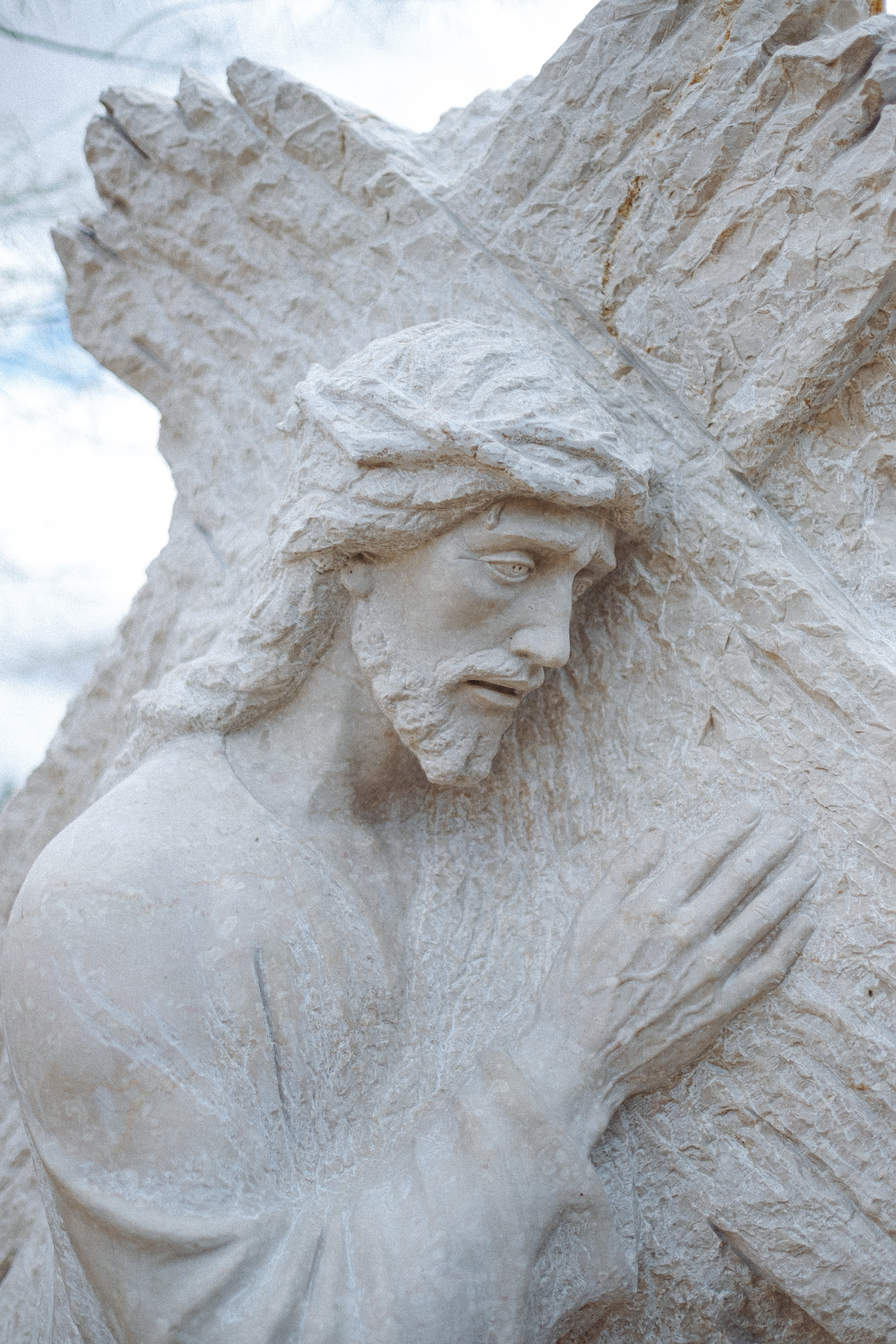
Jesus, weakened from the flogging, cannot make it up Golgotha’s hill. When this becomes obvious to the Roman soldiers, they command Simon of Cyrene to help Jesus. Simon bends to help and lifts the cross, places it on his own back, and looks directly at Jesus with the crown of thorns pressed into His forehead with blood streaming down His swollen face. Simon feels for the man, but can’t help but wonder, “What if they confuse us? What if they think that I’m Jesus since I’m carrying the cross and end up crucifying me?” But this doesn’t stop Simon from serving Jesus. Instead, he takes up the cross and follows Jesus to Golgotha.

But who was Simon of Cyrene? We know he was a real historical person who was there at a real historical moment in time. We know that Simon was from Cyrene, a city in North Africa, in today’s Libya. He was a foreigner, an African, but it’s not certain if he was Jew or Gentile because the name Simon was common for both Jews and Greeks. Finally, we know that Simon helped the Lord in His final moments by carrying His cross. In Luke, Simon is reported to have carried the cross behind Jesus as He walked to Golgotha. Luke is the only one of the Gospels that says Simon carried the cross behind Jesus. All the other Gospels that mention Simon simply say that he carried the cross. Could it be possible that Luke wants us to recall Luke 9:23 where Jesus said, “If any of you wants to be my follower, you must give up your own way, take up your cross daily, and follow me.”? Jesus had challenged His disciples with this scripture, but it was Simon of Cyrene who was available in the moment to serve the Lord. Though far from bearing the weight of our sin, Simon did at least bear the weight of the wooden cross. In that moment, Simon of Cyrene is a portrait of a true disciple of Jesus.

May we all be as true and faithful as Simon of Cyrene, ready to pick up our cross and follow Jesus at a moment’s notice.

Lord, thank You for the example of Simon of Cyrene. Please help me be ready to follow You wherever You may lead.

*Photo courtesy of James and Unsplash.com

The Political Dance of Pilate and the Jews

Now Jesus was standing before Pilate, the Roman governor. “Are you the king of the Jews?” the governor asked Him. Jesus replied, “You have said it.” But when the leading priests and the elders made their accusations against Him, Jesus remained silent. “Don’t you hear all these charges they are bringing against you?” Pilate demanded. But Jesus made no response to any of the charges, much to the governor’s surprise.” (Matthew 27:11-15)

If the story of the murder of Jesus weren’t so tragic, the scene here would be humorous in a dark sort of way. Pilate, the Roman Governor, and the Jews basically hate each other. However, they are forced to dance a strange dance of hated political bedfellows. Pilate doesn’t want to give them anything they want, however he must still keep the peace at all costs. The Jewish religious leaders don’t want Jesus to slip out of their hands, so they are forced to act like they have respect for Pilate. And then there’s Jesus. He is about to walk through the most tragic time of his entire life in order to bestow grace to the world, but He surprisingly remains silent and in total control. Of those in the scene, Jesus is the only one who does not react out of fear or jealousy. His path was completely determined by God’s will and His love for us. 

In the midst of the chaotic, well balanced, fear laden, hate driven dance between Pilate and the Jewish leaders, Jesus is silent, but still in complete control. He is Lord in His submission to the will of God and in the face of the hateful actions of His enemies. He refuses to be goaded into saving or protecting Himself. What is His plan of response to all that is happening? In spite of all that is happening, He dies for us – for you and for me. 

Prayer: Lord, I am in awe of Your restraint and of Your grace. Thank You for showing me that I too can be self-controlled when I fully submit to Your will.