O Come, O Come Emmanuel – The Ancient Christmas Carol With The Surprise Ending

The original author of O Come, O Come Emmanuel is unknown, but it was most likely an 8th or 9th century monk or nun. Roughly 1000 years later, an Anglican priest named John Mason Neale discovered the song while reading Psalterium Cationum Catholicorum, an ancient book of Latin poetry and music. 

Neale lived in the Madeira Islands near the continent of Africa, where he had started an orphanage, a school for girls, and a ministry to reclaim prostitutes. He spoke many languages, including Latin, and was able to translate O Come, O Come Emmanuel into English. He first played and sang it for the people he served, who were considered the lowest of society. It was so well received that Neale included the song in his 1851 collection titled Mediaeval Hymns and Sequences.

The song is written as if you are in the first century and you are awaiting the actual birth of the Messiah. An anticipation is there for what Jesus would bring. The original Latin text contains seven antiphons (verses) which work together to help the reader or singer focus on the coming Christmas. Most modern versions do not include all seven and rarely in the same order as the original. Here are those verses in order and their related meanings:

  • O Sapentia (Wisdom)
  • O Adonai (Hebrew for God)
  • O Radix Jesse (Root of Jesse) 
  • O Clavis David (Key of David)
  • O Oriens (Dayspring)
  • O Rex genitium (King of the Gentiles)
  • O Emmanuel (God with Us)

You can see from the order above that the 8th and 9th century Christians who declared these verses sang them in the opposite order than most people today. Back then, they wouldn’t sing the “O Come, O Come Emmanuel” verse until Christmas Eve. They did this because it was the fulfillment of the song and of the expectation of the Messiah. 

The original Latin text creates a reverse acrostic which is not fulfilled or seen until the last verse is sung. When the ancient worshipers finally sang this verse on Christmas Eve, the reverse acrostic was solved for all the see. The message it proclaimed was “I shall be with you tomorrow.”

Click here to hear For King and Country’s version of O Come, O Come Emmanuel

Click here for Anna Hawkins version in English and Hebrew filmed in Israel

*Image courtesy of Tim Umphreys

O Holy Night: The Christmas Carol Written By An Atheist

I once attended a worship service when, after a failed congregational singing of the Christmas carol O Holy Night, the worship leader stopped the music, looked out at the people, and said, “Well, that was awful.” As hard as it can be to sing, congregations around the world love to at least hear the carol sung skillfully each year. It has a majestic yet mysterious sound. It is regarded as holy but acknowledges the darkness within each of us. It also has a heck of a story.

It was Roquemaure, in southern France, in 1843. The parish priest wanted to commemorate the renovations of the church organ, so he commissioned a written work from the local poet and wine merchant Placide Cappeau. While on an overnight stagecoach to Paris, Cappeau penned “Minuit, Chretiens,” or “Midnight, Christians.” The priest was extremely pleased with the poem, especially because the author was an outspoken atheist. However, the lyrics were so strong, the priest pushed forward and asked Cappeau to share it with Adolphe Adam, a prolific Jewish composer. The resulting Christmas Carol was titled “Cantique de Noel” and premiered in 1847, featuring a local opera singer Emily Laurey.

Even though “Cantique de Noel” was penned by an atheist, composed by a practicing Jew, and performed by a secular artist, it became instantly popular with Christians across France. However, once word reached the church officials that Cappeau was an atheist who publicly spoke out against the church, the song was banned from liturgical use in France. Even so, Cantique de Noel continued to spread outside the church and grew in popularity.

Later, in 1855, John Sullivan Dwight, an American music critic and Unitarian Minister translated the song into English. He was a Transcendentalist and believed there was goodness (and possibly holiness) in everything and everyone. He took some translation liberties with the song. This can be seen in our current version of O Holy Night when the evening itself is seen as being holy. For Dwight, the night was holy in and of itself, not simply because of its connection to Jesus’ birth. Most people missed this completely because the chorus includes the lyric, “O Night when Christ was born.” The song then continued to grow in popularity across the English speaking and French speaking worlds. 

It is believed to have even played a part in the Franco-Prussian War. On Christmas Eve in 1870, French troops started singing “Cantique de Noel” from the battle trenches. In the stillness, German soldiers heard the singing and were moved. In response, they sang a carol by Martin Luther. This impromptu Christmas worship resulted in a 24 hour truce so both sides could celebrate Christmas. Now, there is a strong possibility that this never happened, but the story spread across France making the song wildly popular which resulted in its eventual reinstatement in the liturgy of French churches.

So, there you have it. O Holy Night was a song commissioned to celebrate an instrument, written by an outspoken atheist, composed by a devout Jew, translated by a Transcendentalist, banned from church use in France, finally used as an instrument of peace in a time of war. Most people sing it without concern to its origin, which is probably just as well, but it does go to show you that God can work through the most unlikely of sources to create something beautiful. 

Click here to hear a version of the song sung by Carrie Underwood on the Tonight Show.

*Image courtesy of Markus Spiske

Mary, Did You Know? – The Christmas Song That’s Grammatically Incorrect (According To Some)

It was 1984 and Thomas Road Baptist Church in Lynchburg, Virginia was preparing for their well known Living Christmas Tree presentation. Dr. Jerry Falwell, asked a virtually unknown singer/songwriter/comedian named Mark Lowry to put the program together. Lowry’s plan was to connect Christmas songs with play-like dialogue. 

As Mark Lowry prepared the music and the dialogue, he shared with his mother, Bev Lowry, that he wanted to capture the true essence of the first Christmas. Bev replied, “You know, if anyone knew Jesus was virgin born, it was Mary… and her silence at the cross is proof, I think, that her story was indeed true.” Mark Lowry turned his reflections on this into part of the dialogue for the play, which was wildly successful. However, the words he had written continued to live on him for years. 

In 1991, after Mark Lowry joined the Gaither Vocal Band, he told Buddy Greene, a renowned songwriter who was touring with the band, about the song. Greene asked to see the lyrics so Lowry wrote them down for him. Within thirty minutes, Greene had composed the melody of Mary, Did You Know? Mark Lowry loved the tune and began making preparations to record the song. 

Some sources report a humorous debate about the song between Gloria Gaither, wife of Bill Gaither, and Mark Lowry. Gloria said that the main line of the song was grammatically incorrect. She asked, “Shouldn’t the line actually be ‘Mary, do you know?’” Mark smiled and replied, “My version sings a lot better.” If you try singing the song with “do” instead of “did,” you will probably agree with Lowry.

Even though Lowry loved the song, he was concerned that the range of the song was greater than his own so he asked Michael English, fellow Gaither Vocal Band member to record the song. English agreed and released the song on his debut album. Even though the album was released in January, Mary, Did You Know? became an instant hit and has since been covered by over 500 artists. While more of a Christmas song than a Christmas carol, It has truly become a modern Christmas classic.

Click here to hear Mary, Did You Know performed by Tommee Profitt featuring Jordan Smith.

*Image courtesy of Omar Lopez

**Today’s post is an edited repost from 2021’s collection on Christmas Carol Origin story. Included by special request.

Carol of the Bells – The Christmas Song Born In Ukraine

Carol of the Bells is a favorite Christmas song for millions. Interestingly enough, this haunting, fun Christmas tune owes its origin to a Ukrainian winter well-wishing song whose lyrics had nothing to do with Christmas, or even bells for that matter. 

The original song, titled Shchedryk was written in 1916 by Ukrainian composer Mykola Leontovich. The title is a derivative of the Ukrainian word shchedryj (say that three times fast) meaning bountiful. It tells the story of a swallow flying into a home declaring to its inhabitants that spring is coming soon and that they will have a plentiful new year. Leontovich had been commissioned by choir director Oleksander Koshyts to write a song for a Christmas concert based on Ukrainian folk melodies. He found the famous four note melody and the original lyrics in an anthology of Ukrainian folk melodies and adapted it for choir.

Shchedryk, in its new form, was first performed during a time of intense political struggle in Ukraine. To help their national situation, the Ukrainian government tasked Oleksander Koshyts (who had commissioned Shchedryk from Leontovich) with leading a Ukrainian choir tour across Europe, North America, and South America to promote Ukrainian music. Before their tour was complete, Koshyts choir had performed over 1,000 concerts. This precursor to Carol of the Bells became globally popular as the choir continued to introduce it around the world. It was first performed in the United States to a sold-out Carnegie Hall audience on October 5, 1921.

It wasn’t long before Peter Wilhousky, an American choir director, heard Shchedryk. The repetition of the tune reminded him of bells, so he wrote a new version of the song with new lyrics for his choir. Even though the song had been published in Soviet Ukraine twenty years earlier, Wilhousky published Carol of the Bells in 1936. It wasn’t long before the new version of the song was being performed regularly during the Christmas season across the United States.

Merry, merry, merry Christmas.

Click here to listen to Carol of the Bells as performed by St. George’s Chapel Choir at Windsor

*Photo courtesy of Phil Hearing

Silent Night: The Christmas Carol that Saved Christmas Eve

It was Christmas Eve, 1818, and Pastor Joseph Mohr was getting nervous. For the first time in history, it looked as if it was going to be a Silent Night at the Christmas Eve service at St. Nicholas Church in Oberndorff, Austria. Recent flooding from the Salzach River had put their church organ out of commission and he only had a few hours to come up with a musical alternative. He needed help, and he needed it fast.

Surely filled with anxiety, Mohr walked through the cold to visit his friend Franz Gruber, a school teacher and choir master, who lived in the neighboring town of Arnsdorf bei Laufen. With him, Mohr brought a poem he had written two years prior when walking through a peaceful snowclad forest. It was the epitome of peace to him at the time. Now, that peace was gone, but he had high hopes that Gruber could set the poem to music in time for that evening’s service. Gruber accepted the challenge and within a few hours had composed the melody for Stille Nacht or Silent Night. 

Because the church organ was out of commission, Gruber composed a simple arrangement  for guitar and voice. Franz Gruber and Joseph Mohr traveled back to Oberdorff, where, after a short rehearsal, the two men stood before the people of the St. Nicholas Church and performed their original song. A local choir quickly learned the tune and joined the two friends as they introduced this new Christmas carol to the church, to Austria, and ultimately to the entire world. 

Click here to hear Silent Night as performed by Josh Groban

*Image courtesy of Thomas Galler.

**Today’s post is a repost from 2021 at special request.

Good Christian Men, Rejoice – The Christmas Carol Meant to Encourage

It was the 14th century, a dark time where poverty and hopelessness were extremely common. However, the Suso family was doing ok in the finance department. They had the means for their son Heinrich to become part of the ruling class. but he had other plans. Heinrich had seen the suffering and injustice experienced by the common man and wanted to make a difference in their lives and in the world. So, instead of living the life of luxury available to him, Heinrich became a Dominican monk and worked his hardest to lift the spirits of those people he knew who had very little cause to rejoice about anything. Strangely enough, this was not a common practice of most clergy at the time and Heinrich received a good deal of persecution. 

Good Christian Men, Rejoice was an attempt by Heinrich Suso to encourage those suffering throughout the world. The lyrics were originally in Latin, then quickly translated to German. The song is a true folk song which has been translated and modified in various languages and cultures. Once, it was even reported from Moravian missionaries in Bethlehem, Pennsylvania that the song was sung in thirteen different European and Native American languages in one gathering.

Even though Good Christian Men, Rejoice is ancient and has run the gambit, its message is everlasting to men (and women) of all nations: 

Good Christian men, rejoice, with heart and soul and voice!

Give ye heed to what we say: Jesus Christ is born today!

Ox and ass before Him bow, and He is in the manger now;

Christ is born today! Christ is born today!

Good Christian men, rejoice, with heart and soul and voice!

Now ye hear of endless bliss; Jesus Christ was born for this!

He hath ope’d the heav’nly door, and man is blessed evermore.

Christ was born for this! Christ was born for this!

Good Christian men, rejoice, with heart and soul and voice!

Now ye need not fear the grave; Jesus Christ was born to save!

Calls you one and calls you all, to gain His everlasting hall.

Christ was born to save! Christ was born to save!

Click here to hear Good Christian Men, Rejoice by Reawaken Hymns

*Image courtesy of Kolby Milton

Let All Mortal Flesh Keep Silence: The Ancient Christmas Carol That Ushers In Christmas Communion

When I was a child, to feign off boredom in church, I used to thumb through the hymnals. Once, when I was visiting a friend’s church, I came across the Christmas hymn Let All Mortal Flesh Keep Silence. Tired of people telling me to be quiet, I moved on. The next time I remember hearing the song, I was in college. I borrowed my friend’s Cynthia Clawson Hymnsinger cassette tape (Ok, so I’m old) and listened to the song multiple times. I found it mysterious and even somewhat haunting, but honestly, I paid little attention to the lyrics.

Let All Mortal Flesh Keep Silence is one of the oldest Christmas hymns still in use. It’s based on the Prayer of the Cherubic Hymn in the Liturgy of St. James. This liturgy was thought to be the work of James, the brother of Jesus, but now it’s believed that it was written during the 4th century and is often referred to as the Liturgy of Jerusalem.

Using portions of the Psalms, Isaiah 6, and Revelation 4, Let All Mortal Flesh Keep Silence compels the worshipers to engage in welcoming the Incarnation of Christ and gain a sense of actually entering into the Holy of Holies. Obviously, it was written from the perspective that the bread and wine actually transform into the body and blood of Jesus during communion. To add to the dramatic flair, It was sung as the communion bread and wine were carried into the place of worship. 

During the liturgy, the leader would say, “We remember the sky, the earth and the sea, the sun and the moon, the stars and all creation both rational and irrational, the angels and archangels, powers, mights, dominations, principalities, thrones, the many-eyed Cherubim who say those words of David: ‘Praise the Lord with me.’ We remember the Seraphim, whom Isaias saw in spirit standing around the throne of God, who with two wings cover their faces, with two their feet and with two fly; who say: ‘Holy, holy, holy, Lord of Sabbath.’ We also say these divine words of the Seraphim, so as to take part in the hymns of the heavenly host.”

No matter your stance on what happens to the bread and wine (or juice) during communion, it is easy to see how this Christmas hymn would enhance the worship experience of these ancient Christian worshipers. What better way to celebrate the birth of our Savior than to focus on his life’s purpose of giving His life, His blood, His body for us. 

Check out the lyrics written below.

Let all mortal flesh keep silence, and with fear and trembling stand;

Ponder nothing earthly minded, for with blessing in His hand

Christ our God to earth descendeth, our full homage to demand.

King of kings, yet born of Mary, as of old on earth He stood,

Lord of lord, in human vesture – in the body and the blood.

He will give to all the faithful His own self for heavenly food.

Rank on rank the host of heaven spreads its vanguard on the way, 

As the Light of light descendeth from the realms of endless day,

That the pow’rs of hell may vanish as the darkness clears away.

At His feet the six-winged seraph, cherubim, with sleepless eye,

Veil their faces to the Presence, as with ceaseless voice they cry,

“Alleluia, alleluia! Alleluia, Lord most high!”

Click here to hear Cynthia Clawson’s short arrangement of Let All Mortal Flesh Keep Silence. Click here to heard the full version by Fernando Ortega

*Image courtesy of Dan Kiefer

We Three Kings, The Christmas Carol I Learned As A Parody

I was first introduced to We Three Kings as a child through its parody. On the school bus, other kids and I sang: We three kings of Orient are smoking on a rubber cigar; It was loaded, it exploded, now there are only two… Unfortunately, the Wise Men in our version didn’t learn from their mistakes because one by one they were exploded by the loaded rubber cigar. Then we sang, “Silent Night…”

Yes, it was childish and silly, but I was a child. 

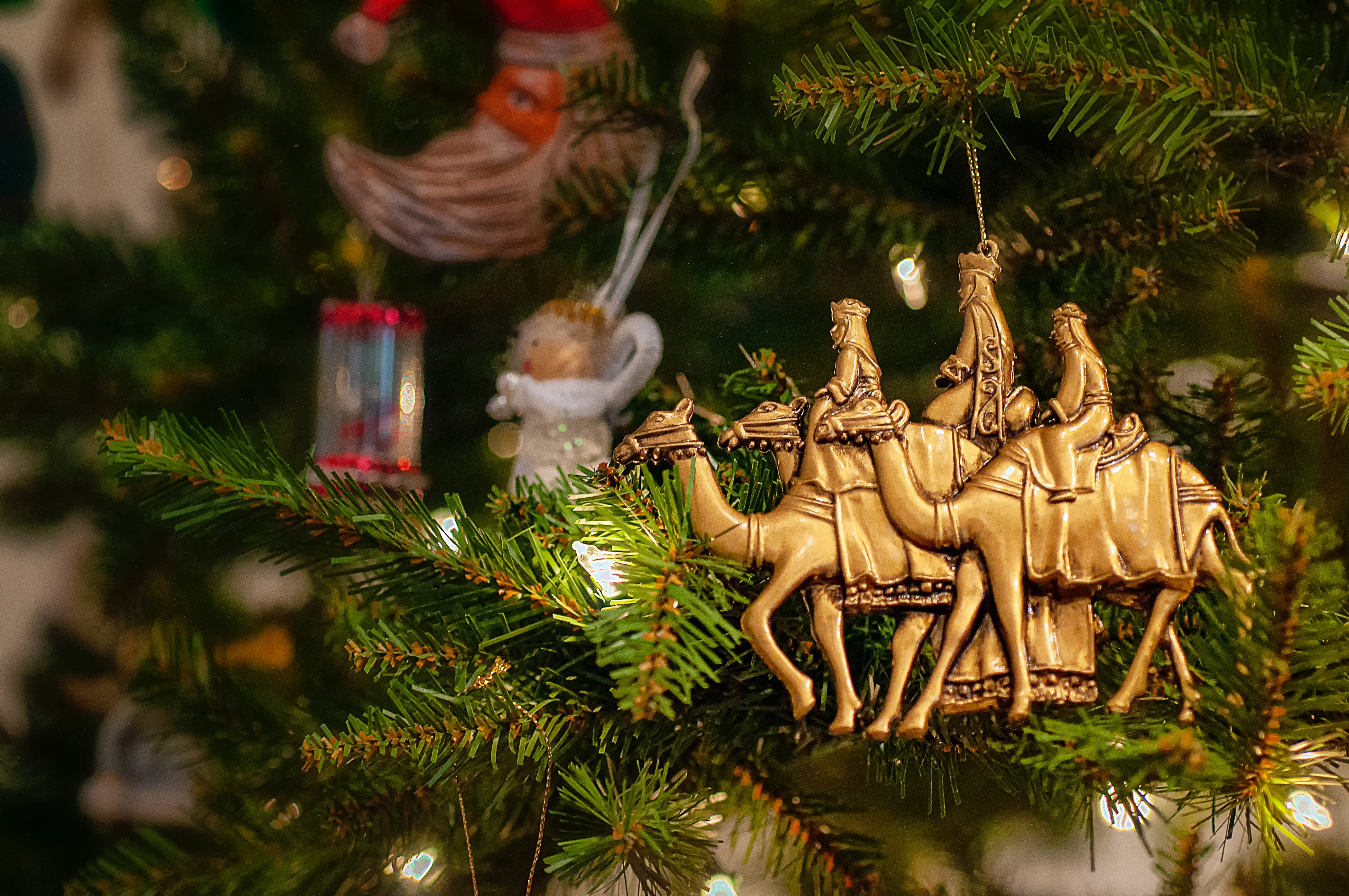
The first time I heard the legitimate version was in church, where three deacons dressed in bath robes and head pieces trying to portray the three kings as they followed the star searching for the Messiah. I laughed quietly when I saw them, not only because they looked funny, but because I thought it was kind of hokey to include the Christmas carol in the church production (Again, I was a kid and didn’t know any better). I later learned that the carol was actually written for a Christmas production in 1857 by composer John Henry Hopkins, Jr. He served as a music teacher at the General Theological Seminary in New York City. He desperately desired to write a song which featured the gifts presented by the wise men to baby Jesus.

We Three Kings originally contained five verses. The first and last verses were meant to be sung by all three wise men. Each of the verses in between were written as a solo for the wise man carrying gold, frankincense, or myrrh. Each solo describes the purpose of each respective gift. Gold was a gift for a king. Jesus was born King of kings. Frankincense was often carried by priests in worship of the Lord. Jesus Himself was and is God. Myrrh was a spice used in burial. This signified Jesus as the perfect sacrifice for our sins. 

Verse 1: We three kings of Orient are; bearing gifts we traverse afar,

Field and fountain, moor and mountain, following yonder star.

Refrain: O star of wonder, star of light, star with royal beauty bright,

Westward leading, still proceeding, guide us to thy perfect light.

Verse 2: Born a King on Bethlehem’s plain, gold I bring to crown Him again,

King forever, ceasing never, over us all the reign. (Refrain)

Verse 3: Frankincense to offer have I; incense owns a Deity nigh; 

Prayer and praising, voices raising, worshiping God on high. (Refrain)

Verse 4: Myrrh is mine; its bitter perfume breathes a life of gathering gloom;

Sorrowing, sighing, bleeding, dying, sealed in the stone-cold tomb. (Refrain)

Verse 5: Glorious now behold Him arise; King and God and sacrifice:

Alleluia, Alleluia, sounds through the earth and skies. (Refrain)

Check out this version of We Three Kings by the Hound and the Fox and Tim Foust.

*Image courtesy of Robert Thiemann

The Friendly Beasts – The Christmas Carol About the Animals in the Nativity Story

Over the years, I’ve heard hundreds of Christmas carols and songs. I’ve sung in dozens of Christmas choirs and even directed multiple Christmas musicals. To top things off, last year I started blogging about the origins of Christmas Carols. I asked my social media friends to submit their favorite Christmas carols for me to research. When numerous people submitted The Friendly Beasts, I thought it was a joke because I was totally unfamiliar with the song. Fans of Garth Brooks, Burl Ives, Johnny Cash, and Harry Belafonte were not impressed.

The Friendly Beasts originated in 12th century France, probably by Pierre de Corbeil who was the Bishop of Sens. The melody of the donkey portion was originally sung during the Fete de l’Ane or Festival of the Donkey. Instead of focusing on the birth of Jesus, this festival actually focused on the holy family’s flight to Egypt. During the Catholic mass for this festival, a donkey was often ridden or led into the church building. 

Over the years, the festival shifted from the Holy family’s flight into Egypt to Joseph and Mary’s journey to Bethlehem. As time passed, The Friendly Beasts featured verses highlighting the cow, the sheep, the doves, and the camel. As Jesus is born, each of the “friendly beasts” experience a magical event where they are each able to sing about the gifts they are offering to Jesus: 

The donkey gave transportation for Mary to Bethlehem

The cow gave its manger as a place for Jesus to sleep

The sheep gave their wool for a warm coat.

The doves coo the baby Jesus to sleep.

The camel carried the wise men who brought gifts to Jesus

Some connect this song to old beliefs that all animals have the gift of speech at midnight on Christmas Eve. One comment I read said, “If God gave Balaam’s donkey the ability to speak (Numbers 22), why wouldn’t he do the same to the animals of the Nativity? Exploring this would be a post (if not a research paper) of its own. I understand that the story is more legendary than biblical. But, it’s still a sweet notion to think that the animals in the stable were able to participate in honoring Jesus at his birth. 

It also brings to mind Psalm 148:7-13 – Praise the Lord from the earth, you creatures of the ocean depths, fire and hail, snow and clouds, wind and weather that obey Him, mountains and all hills, fruit trees and all cedars, wild animals and all livestock, small scurrying animals and birds, kings of the earth and all people, rulers and judges of the earth, young men and young women, old men and children. Let them all praise the name of the Lord. For His name is very great; His glory towers over the earth and heaven!”

Click here to hear The Friendly Beasts by Garth Brooks and friends

*Image courtesy of Martin Castro

Sweet Little Jesus Boy – The Christmas Song Written As An Apology to Jesus

One of the sweetest Christmas songs I heard as a child was Sweet Little Jesus Boy. Like many, I assumed it was a spiritual first sung by the slaves of the American South. You can imagine my surprise when I learned that the song was written in 1934 by Robert MacGimsey, a white lawyer.  

MacGimsey was born in Pineville, Louisiana and grew up with black domestic help including “Aunt Becky,” his caregiver. When he was an infant and young child, Becky sang spirituals to young Robert. She and other workers in the MacGimsey home gave Robert a rich background in the gospel music of the south. 

Robert MacGimsey grew to adulthood and began practicing law, but he also wrote and published songs throughout his life. No matter where Robert traveled, he never forgot his Aunt Becky and the songs she sang to him as a child. In fact, Robert focused his life’s work on making African-American folk music of the South known and accessible by the world. 

Sweet Little Jesus Boy was written because of a personal experience. One Christmas Eve, MacGimsey was walking through the snowy streets of New York City. He was appalled by the number of people visiting various nightclubs who chose to celebrate Christmas by getting drunk instead of focusing on who Jesus was and why He came into the world. To Robert, Christmas was a time of worship and praise. So, he penned the lyrics to Sweet Little Jesus Boy as an apology to Jesus because, as goes the refrain, “We didn’t know who you was.”

Sweet Little Jesus Boy was written to reflect the lives of black Christians during the Civil War. Robert MacGimsey once stated that as he wrote the song, he “pictured an aging black man whose life had been full of injustice standing in the middle of a field giving his heart to Jesus in the stillness.” As you read through the lyrics below, you can almost picture this taking place. 

Sweet little Jesus Boy-they made you be born in a manger.

Sweet little Holy Child-Didn’t know who You was.

Didn’t know You’d come to save us, Lord; 

To take our sins away.

Our eyes was blind, we couldn’t see, 

We didn’t know who You was.

Long time time ago, You was born, born in a manger low,

Sweet little Jesus Boy, the world treat You mean, Lord,

Treat me mean, too, 

But that’s how things is down here-

We don’t know who You is.

You done told us how, we is a trying’!

Master, You done show’d us how, even when You was dyin’.

Just seem like we can’t do right,

Look how we treated You.

But, please, Sir, forgive us, Lord-

We didn’t know ‘twas You.


Listen to Sweet Little Jesus Boy sung by Mahalia Jackson on the Ed Sullivan Show on December 18, 1960.

*Image courtesy of Michael Payne