My Enemy at the Grocery


People think that creativity is about discovery. It’s not. It’s about connection.
Steve Jobs, in a 1996 interview with Wired, was asked to define Creativity. He said the following:
Creativity is just connecting things. When you ask creative people how they did something, they feel a little guilty because they didn’t really do it, they just saw something. That’s because they were able to connect experiences they’ve had and synthesize new things. And the reason they were able to do that was that they’ve had more experiences or they have thought more about their experiences than other people.
The best creative ideas rarely come fully formed. Even those who are “divinely inspired” come as the result of interesting connections, conversations, contemplations, and experiences. To increase our creativity, we should foster our curiosity, allowing our ideas and projects time to come together. Rushing creativity can get you by, but rarely is the result amazing.
*Photo courtesy of Me Badr Chemmaoui on Unsplash


Some of our most beloved Christmas songs, when you stop to consider the lyrics, are not really about Christmas. Jingle Bells, Sleigh Ride, and Winter Wonderland are more about the winter season than they are about Christmas. My Favorite Things is from the musical The Sound of Music and takes place when children are frightened by a storm. Finally, Let It Snow and Baby It’s Cold Outside are about…well…not Christmas, that’s for sure.
And then, there’s the beloved Christmas carol Joy To The World, which as it turns out, is not really about Christmas at all.
Joy To The World, sung mostly at Christmastime, has more to do with the second coming of Jesus than the first. Isaac Watts, the English poet and originator of the lyrics, draws the song’s initial inspiration, not from the birth of Jesus narrative in Luke 2, but from Psalm 98. He paraphrased Psalm 98 in his collection titled The Psalms of David, Imitated in the Language of the New Testament. Joy to the World was taken from his portion titled The Messiah’s Coming and Kingdom based on the following from the King James Version:
Make a joy noise unto the Lord, all the earth: make a loud noise, and rejoice, and sing praise. Sing unto the Lord with the harp; with the harp and the voice of a psalm. With trumpets and sound of cornet make a joyful noise before the Lord, the King. Let the sea roar, and the fullness thereof; the world, and they that dwell therein. Let the floods clap their hands: let the hills be joyful together. Before the Lord; for he cometh to judge the earth: with righteousness shall he judge the world, and the people with equity. Psalm 98:4-9
So, how did the song become a Christmas song? Possibly from the combination of the poem by Isaac Watts with the music of George Frederic Handel, composer of The Messiah orotorio. Even though Handel and Watts may have known each other, they did not work together to create the Joy To the World song we sing today. A third party combined the Watt’s words with musical portions from Handel’s Messiah to create the tune that is sung today in North America. Since Handel’s Messiah is associated with Christmas and contains a “Christmas” section, the breakaway song, Joy to the World, has always been associated with Christmas.
So there you have it, one of the most beloved Christmas carols of all time is not a Christmas song. Does it matter? Not really. Enjoy it and use it to worship the Lord, who was born in Bethlehem as a baby and will one day return to judge the world with righteousness.
Merry Christmas.

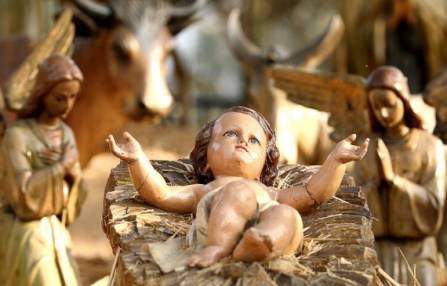
A few years ago, as Christmas approached, I was going through some personal struggles and even considered leaving the ministry. However, as I sat to review the worship music for the beginning of the Christmas season, I couldn’t stop singing the lyrics to Away In A Manger, one of my favorite Christmas carols. I love the simplicity of the song and am always impressed by the childlike faith it evokes.
Here are those first three stanzas:
Away in a Manger, no crib for a bed, the little Lord Jesus laid down His sweet head. The Stars in the sky looked down where he lay, the little Lord Jesus asleep on the hay.
The cattle are lowing, the baby awakes, but little Lord Jesus, no crying he makes. I love thee, Lord Jesus, look down from the sky, and stay by my cradle til morning is nigh.
Be near me, Lord Jesus, I ask thee to stay, close by me forever and love me I pray. Bless all the dear children, in thy tender care, and fit us for heaven to live with thee there.
However, as I sang, I felt the song wasn’t complete, so on that day, I wrote two extra stanzas. Doing so help restore my faith and hope in the Lord. I pray they minister to you as you read them below.
No longer a baby, He grew to a man, sent to us from heaven to fulfill God’s plan. He died on a cross to atone for our sin, then rose from the dead to be alive again.
This precious Lord Jesus is all that we need, if we make him our Savior and our Lord indeed, Oh please, wondrous Jesus, be with us today. Fill us with your spirit, we now humbly pray.
Merry Christmas.
*photo courtesy of Unsplash


I am greater than you.
Even if we aren’t aware of it, we say it all the time, in different ways to multiple people.
Kids say it on the playground.
Teenagers express it through segregation at lunchtime.
Adults express it when they drive off of the new car lot.
Pastors, deacons, teachers, and worship leaders convey it in their attitudes toward each other and toward others in the church.
I am greater than you.
Huge ministries sometimes fall because of leadership corruption and abuse, small church plants often begin out of spite, and confusing divisiveness invades the worship services, Bible studies, and prayer times of countless congregations. And all the while, the unchurched learn more about our vindictiveness and positional desires than our Christlike compassion and concern for their eternal destiny. What they see is the Body of Christ pointing fingers at each other, declaring to the world and the rest of the church:
I am greater than you.
Jesus had the same problem with His disciples. Shortly after His transfiguration, Luke reports that His disciples began arguing about which of them was the greatest (Luke 9:46 NLT).
I first heard this story when I was a child in the 70’s. I envisioned the disciples walking behind Jesus, saying “I’m greater than you and you and I’m certainly greater than you.” Even as an elementary student, it seemed so childish and stupid to me that the disciples were standing right behind Jesus, God the Son, and they had the audacity to argue with each other and say:
I am greater than you.
I love how Jesus handled the situation:
But Jesus knew their thoughts, so He brought a little child to His side. Then He said to them, “Anyone who welcomes a little child like this on my behalf welcomes me, and anyone who welcomes me also welcomes my Father who sent me. Whoever is the least among you is the greatest.” (Luke 9:47-48)
In Jesus’ day, children were not regarded as highly as they are today. This helps us see that He was saying that whoever welcomes and is willing to serve the lowest of the low welcomes and serves God Himself. It’s not hard to discern that this is not an attitude most often exhibited from those who want to exalt themselves over others.
The apostles learned this lesson when James and John asked Jesus if they could sit on His right and His left in the kingdom. The Bible reports that the other disciples were angry with these brothers because of their request.
“So Jesus called them together and said, “You know that the rulers in this world lord it over their people, and officials flaunt their authority over those under them. But among you it will be different. Whoever wants to be a leader among you must be your servant, and whoever wants to be first among you must be the slave of everyone else. For even the Son of Man came not to be served but to serve others and to give His live as a ransom for many” (Mark 10:42-45)
Jesus, the greatest person who has ever lived, took on Himself the attitude and position of a servant. He did this, even though He could have looked at us all and said:
I am greater than you.
If Jesus, the Son of Man, came not to be served but to serve others, shouldn’t we be able to do the same with each other and with the world around us. If we do, we’ll be showing the world and other Christians that we believe:
He is greater than us
*Photo by Sabri Tuzcu on Unsplash


Honesty may be the best policy, but deception and dishonesty are part of being human. That sentence is a direct quote from a recent article I read in a National Geographic article (June 2017) titled Why We Lie. The article even stated that Learning to Lie is a natural stage in child development. I’m not one who is overly prepared to discuss human development, but I do know that it’s not hard to see that dishonesty is prevalent in our society today. It is also rampant in our churches as well, especially in corporate worship.
Let me explain.
Charles Spurgeon once said, A lie can travel half way around the world while the truth is putting on its shoes. He makes a good point, and Christians should be the first ones to understand the importance of truth, especially since we worship the One who is the Way, the TRUTH, and the Life. (John 14:6) However, instead of heralding truthfulness, we often champion deceit, inaccuracy, and falsehood, especially when we’re with other Christians in corporate worship.
To quote A.W. Tozer, Christians don’t tell lies, they just go to church and sing them.
I know we look like pillars of integrity when we stand to sing, sometimes with our hands raised high, but the question remains, do we honestly, wholeheartedly, sincerely, mean the words that are coming out of our mouths?
When I was a child, one of my favorite hymns was My Jesus, I Love Thee written by William R. Featherstone. The first stanza contains the lyrics, “For Thee, all the follies of sin I resign…” Even when I have the opportunity to sing that song now, I belt it out with all my heart, but when I reflect on the words, I must ask myself, “Have I really resigned from all follies of sin?” Sadly, the answer is most often, “No, I haven’t.”
One of my favorite worship songs now is When You Walk Into The Room by Bryan and Katie Torwalt. However, there are lyrics within the song that cause me to doubt my level of honesty with the Lord. For example, one line says “We can’t live without You, Jesus…” I’m lying if I say I always keep Jesus at the center of my life. Being a selfish person, I constantly try to live my life without Jesus’ influence. So, often, when I sing those words, I feel more conviction than rejoicing.
So, is the answer to stop singing and participating in corporate worship? Absolutely not. These internal struggles are part of the process of worship. In worship, we come to terms with the holiness of God and therefore, reflect on our own sinfulness. In Isaiah 6, which I learned in college is a textbook example of an ultimate worship service, Isaiah sees the Lord. He’s awed by the power that is before him. He hears the seraphim singing “Holy, holy, holy is the Lord of Heaven’s armies! The whole earth is filled with His glory!” (Isaiah 6:3). As Isaiah is taking all of this in, he is completely overwhelmed by the Lord’s holiness, and then he comes to grips with his own sinfulness. He cries out, “It’s all over! I am doomed, for I am a sinful man. I have filthy lips, and I live among a people with filthy lips.” (Isaiah 6:5a)
Isaiah knew that if he were to join the seraphim in singing “the whole earth is filled with His glory” that his own life would need to reflect the glory of God. The same is true for us with the songs we sing in worship. If we’re going to sing, “The sun comes up, it’s a new day dawning, it’s time to sing Your song again…” (10,000 Reasons – Matt Redman), then we should be willing to rise in the morning, remembering who He is, and being willing to lift up His name in song, and willing to submit our day to His will.
So, let’s determine to sing songs, hymns, and spiritual songs to the Lord with hearts that are pure and ready to confess. As we enter into worship, let’s encounter his holiness and repent of our own sinfulness. Let us be filled with integrity in our worship, lifting Him up in Spirit and in TRUTH.

Do you ever feel worthless? Good for nothing? Without purpose? Inconsequential? Expendable? Unlovable? Ordinary?
If the answer is yes, you’re not alone. I’ve struggled with these feelings myself at times.
Millions of people, just like us, wake up each day, go through the motions of their lives, all the while feeling totally insignificant and utterly useless. Often, when these thoughts of unworthiness exist, we naturally equate them to the way that God must feel about us.
In the musical, Little Shop of Horrors, flower shop worker Seymour sings these words: “Poor, all my life I’ve always been poor. I keep I asking God what I’m for, and He tells me ‘Gee, I’m not sure. Sweep that floor kid.”
I’m not saying it’s right, but those of us who sometimes feel they live in a pointless existence often feel as if God made a mistake when He created us. Like Seymour, we feel like we must live our lives day to day fulfilling mundane tasks. For the record, I’m not saying that sweeping the floor is insignificant. Floors get dirty and must be swept. Some people who sweep floors live very fulfilling and purposeful lives. Others of us though, like Seymour, are sometimes overwhelmed with a sense of worthlessness, and therefore any task, no matter how common or grandiose, can feel routine and commonplace, leaving us feeling dry and unimportant.
These feelings may sometimes come upon us because we forget that God created us in His image. In Genesis 1:27, we see that God created man in His own image; He created him in the image of God; He created them male and female.
We were formed in the image of God. That means something. Our lives are not accidents. God made us on purpose. We have worth. We have value. God formed us after Himself. He loves us and has great purposes for our lives. Every single day was planned out for us before we were even born.
The Psalmist wrote: I will praise You because I have been remarkably and wonderfully made…Your eyes saw me when I was formless; all my days were written in Your book and planned before a single one of them began. (Psalm 139:14a, 16)
God didn’t create the planets, earth, sun, moon, stars, rocks, rivers, canyons, mountains, trees, birds, or animals to be like Him, though they do reflect His glory. Instead, He formed us after Himself, in His image. He made each one of us special.
Whenever I felt this struggle within me, I pray something like this: Lord, thank You for creating me in Your image. In that alone, I have great value. Help me to remember that today and everyday. Amen.
Do you ever feel worthless? If so, trying praying that short prayer above. Try remembering that God created you in His image with great purposes in mind. In that itself, you have great value.
*Photo by Evan Kirby, courtesy of Unsplash