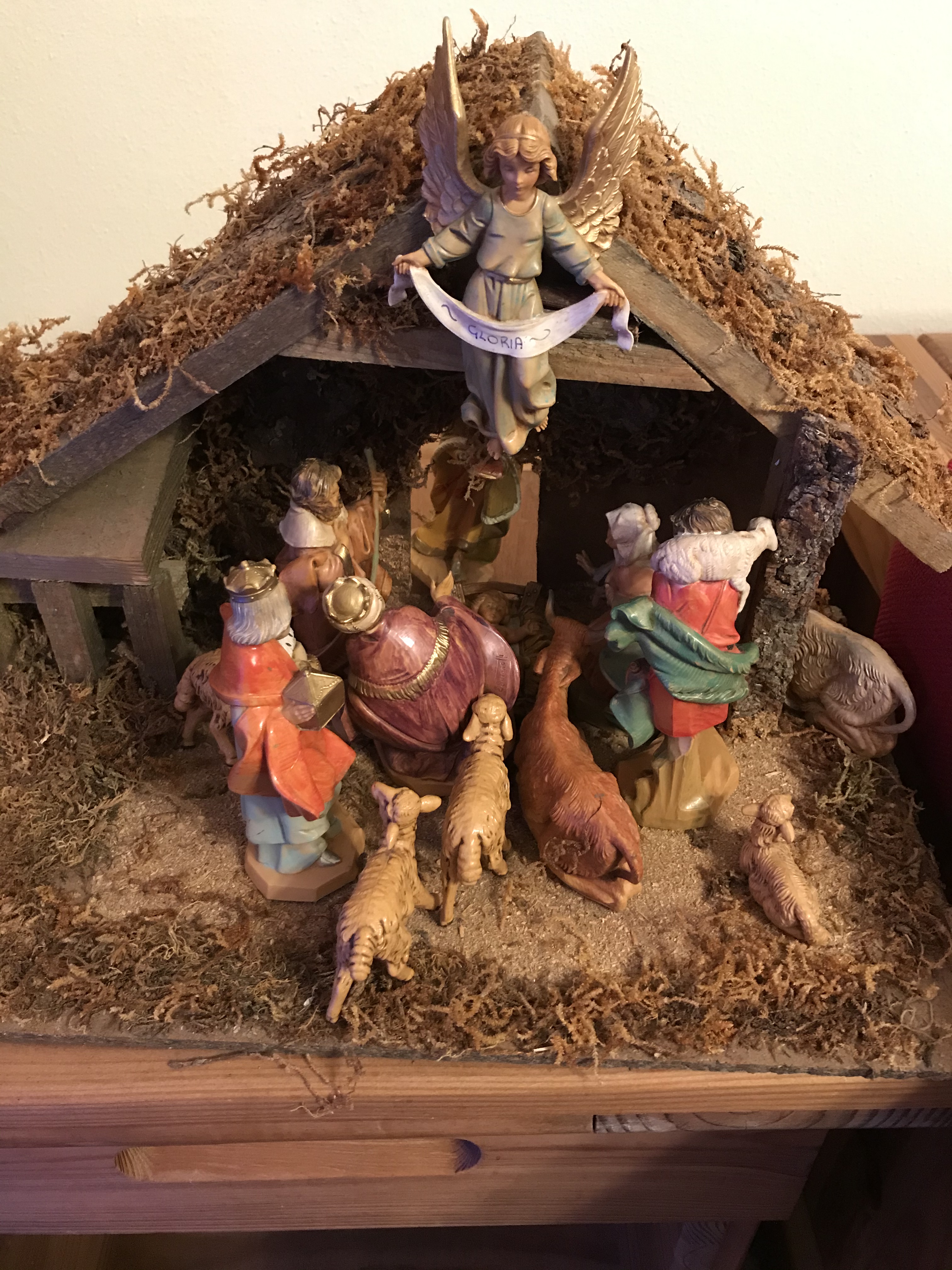
A few years ago, my wife invited a mom and her preschool daughter to our home to help decorate for Christmas. She asked the young girl if she would place the Nativity scene figures in a small stable that was sitting on an end table near our sofa. The little girl smiled upon hearing the opportunity. She looked carefully at each piece before placing the Baby Jesus figure, who was of course lying in a manger, in the center of the stable. Then, she slowly placed Mary and Joseph, the animals, the shepherds, the wise men, and finally, the angel.
Sounds pretty normal, right? Most people would probably use the same process.
Except…
Instead of facing the figures outward, this young girl placed them facing the center of the stable.
I remember thinking, “What has she done? These characters aren’t facing the people who will be looking at the nativity scene. They look like they’re just focused on Jesus.”
Then, I realized that she had it right. Jesus is the center of the story. It’s all about Him. Why would the figures look at anything or anyone else but Him?
That’s a good life lesson for us all as well. This year, let’s fix our eyes on Jesus. Let’s make Christmas all about Him.
I hear the question every December: “Is Christmas Really Jesus’ Birthday?”
In short, yes and no.
The argument, as I see it, is less about Christmas and more about December 25th.
Many people believe that Christmas is actually based on Saturnalia, a pagan festival for Saturn, the Roman god of agriculture and time. This festival began as a single day held on December 17 yet by the first century before Christ, it had expanded to a seven day festival. Saturnalia was a holiday for everyone, even the enslaved. Homes were decorated with wreaths and greenery. Saturnalia led to another Roman holiday connected to the winter solstice which recognized the birthday of the Roman sun god Sol Invictus.
On the other hand, some theologians believe that the Annunciation (when the angel Gabriel shared with Mary that she would give birth to the Son of God) took place on March 25. Therefore, since the average term of a human pregnancy is 9 months, the due date for the Messiah must have been December 25.
The Roman Emperor Constantine was raised in the cult of the Unconquered Sun God and most likely celebrated Saturnalia and worshiped Sol Invictus. However, Constantine converted to Christianity in 312. Shortly after, he declared it the official religion of the Roman empire. He made a conscious effort in turning the culture of his day away from paganism and toward Christ. Because of his influence, western Christians began celebrating Christmas (Christ Mass) on December 25 in 336. Constantine’s efforts were continued by Pope Julius 1st, who declared in 385 that Christmas, the celebration of the birth of Jesus, would be observed on December 25.
So, when was Jesus born? Lee Strobel, author of The Case For Christmas, states that it must have been in the spring because shepherds were watching their flocks by night, which they would have done in the spring when ewes bore their young.
That makes sense to me.
But does it really matter?
Several years ago, my wife wished our niece a happy birthday on her actual birthday. “Thank you,” she replied, “But my mom changed my birthday this year so tell me again this coming Saturday.” Her mother didn’t really change her birthday, just the time of the celebration of her birthday. But we still had cake and presents and sang “Happy Birthday” to her on the day of celebration.
Point being, the date didn’t change the importance of our niece’s birthday. In a similar way, we celebrate the birth of Jesus on the 25th of December, knowing full well He could have just as well been in March, April, or August. Celebrating the birth of Jesus is what’s important, not the date.
But what about those practices that came along with Saturnalia? Are we somehow worshiping the sun god as we hang our wreaths, drape our garland, go caroling in our neighborhoods, and exchange gifts?
I believe the answer lies in intentions.
It’s doubtful, at least to me, that the ancient Roman Christians were trying to trick us all into worshiping the sun. They were most likely seeking an alternative to Saturnalia and wanted to focus on Jesus instead of the pagan god, so they began celebrating Christmas instead. Overtime, the intent of Saturnalia was overtaken by the celebration of Jesus’ birth. In a sense, this festive time of the year was redeemed by these early saints.
There are probably some people who hang their decorations and celebrate Saturnalia instead of Christmas, but that is not my intent. I imagine it’s not your intent either.
Being a song that was passed down orally, The First Noel may date to the 13th or 14th century. Some believe the song was inspired by a dramatization of the Christmas Story where actors would act out vignettes as they sang. The song does tell the story of Jesus’ birth from Matthew 2 and Luke 2, and would have worked well as a dramatized song with a repeating chorus.
The word “Noel” is French for “Christmas” which is derived from the Latin word “Natalis,” meaning “Birthday.” Even though “Noel” works well for the chorus of The First Noel, it’s strange to consider that when the ancient singers arrived at the chorus of each verse that they were simply singing, “Christmas, Christmas, Christmas, Christmas….”
The First Noel was first published by Davies Gilbert in 1823 in Some Ancient Christmas Carols. Ten years later, William Sandys published the song in Christmas Carols Ancient and Modern increased the popularity and prominence of the carol. The song originally had nine stanzas, but five are most commonly used today. In most recordings, artists rarely perform more than two or three verses which is a shame because it causes people to miss out on the story of the song. Though the angels appear to the shepherds in the first verse, most of the carol focuses on the journey of the wise men, giving the carol an Epiphany focus. The fourth verse is one of my favorites:
“This Star drew nigh to the Northwest; O’er Bethlehem it took its rest.
And there it did both stop and stay, Right over the place where Jesus lay.”
Merry Christmas.
Click here to read all nine verses of The First Noel.
Click here to hear Claire Crosby and Family sing The First Noel
Pastor Phillips Brooks was a staunch abolitionist, which was probably why he was asked to speak at the funeral of President Abraham Lincoln. However, he is most remembered for writing the lyrics for the Christmas carol O Little Town of Bethlehem.
Shortly after the American Civil War, Brooks took a sabbatical to the Holy Land which extended through the Christmas holidays. On Christmas Eve, Brooks traveled from Jerusalem to Bethlehem on horseback so he could attend a service in Constantine’s ancient basilica, built over the potential site of the Nativity. Of his journey, Brooks reported: “Before dark we rode out of town to the field where they say the shepherds saw the star. It is a fenced piece of ground with a cave in it, in which, strangely enough, they put the shepherds…Somewhere in those fields we rode through, the shepherds must have been.”
It was here, in the fields outside Bethlehem that Brooks first conceived the line: “O Little Town of Bethlehem, how still we see thee lie. Above thy deep and dreamless sleep, a silent star goes by.” Several years later, Brooks finally completed the song and asked Lewis Redner, his organist, to write the music. The song was first performed by the children’s choir of their church. It wasn’t long before the song was included in hymnals worldwide.
Even though Phillips Brooks and his wife never had children of their own, they had a great love for children. Later in life, they met and ministered to young Helen Keller, who was born blind and deaf. Brooks explained the gospel of Jesus to Keller for the first time. Keller, through her teacher and translator Anne Sullivan, said, “I’ve always known there was a God, but until now I’ve never known His name.”
Even though the third verse of O Little Town of Bethlehem waswritten long before Helen Keller met Phillips Brooks, it shares what the joy of salvation might have felt like to her:
How silently, how silently, the wondrous gift is given!
So God imparts to human hearts the blessing of His heaven.
No ear may hear His coming, but in this world of sin,
Where meek souls will receive Him still, the dear Christ enters in.
Click here to hear O Little Town of Bethlehem performed by Chris Tomlin.
The Advent Hymn, Lo, How A Rose E’er Blooming was originally a German Catholic hymn titled Gebetbuchlein des Frater Conradus (Say that 3 times fast). The manuscript containing the song was found in St. Alban’s Carthusian monastery in Trier, Germany, so its original authorship is anonymous. The song was focused on Mary, the mother of Jesus, who is compared to the rose mentioned in Song of Solomon 2:1 – “I am a rose of Sharon, a lily of the valleys.” The story is told that one Christmas Eve, a monk found a rose blooming in the woods. He placed the rose in a vase and placed it before the altar of Mary. Whether that is true or not, the song was published somewhere around 1582. This first version had 19 verses.
By 1609, Protestants had adopted the song and changed its focus from Mary to Jesus citing Isaiah 11:1 – “Out of the stump of David’s family will grow a shoot, yes, a new branch bearing fruit from the old root.” Not to be outdone by the Catholics, the 1599 Cologne, Germany Protestant version of the song was published with 23 verses in Alte Katholische Geistliche Kirchengesang,which is a hymnal of sorts. I can just see the preacher now saying, “Ok, we’re going to sing all 23 verses unless someone makes a decision before the second verse.”
The version most known today was given a new tune by Michael Praetorius in 1609. Most collections today ironically contain only 2-3 verses.
Click here to hear a version of Lo, How A Rose E’er Blooming by Reawaken Hymns
Adeste Fideles, is a Latin hymn which is translated O Come, All Ye Faithful. The official authorship has been given to John Francis Wade (1711-1786), whose name is included on most if not all of the earliest manuscripts. Even so, the lyrics and tune appear to be the result of a collaboration of several people over hundreds of years, although what we sing today is a 19th century version of an 18th century compilation.
Some believe that Adeste Fideles is not actually about Christ, but is instead about Bonnie Prince Charlie, grandson of James II, England’s last Catholic king. In 1745, Bonnie Prince Charlie led a rebellion to restore the Catholic House of Stuart to the English throne. Fideles is believed to mean Faithful Catholic Jacobites. Bethlehem is also believed to be a term for England. If this is true, the song is actually a war cry shouting out, “Come and Behold Him, Born the King of the English.”
More recently, others believe that the 1980’s rock band Twisted Sister sampled the melody of their biggest hit, We’re Not Gonna Take It from O Come, All Ye Faithful. The melodies of the songs are very similar, but it’s purely coincidental. Jay Jay French, lead guitarist of Twisted Sister stated in a radio interview that the band discovered the similarities and recorded a version of O Come, All Ye Faithful for their Christmas album A Twisted Christmas.
I suppose I can ignore the possibility of O Come, All Ye Faithful having its origins with Bonnie Prince Charlie if it results in a song that God can use to get a rock group like Twisted Sister to sing “O Come, Let Us Adore Him, Christ the Lord!”
Click hereto hear Adeste Fideles by Andrea Bocelli
Click here to hear O Come, All Ye Faithful by Tasha Cobbs
Click here to hear O Come, All Ye Faithful by Twisted Sister
*Image courtesy of Tim Mossholder **This post and others like it can be found at www.johnjfrady.com
In The Bleak Midwinter is one of my favorite Christmas carols. It’s name may be the reason it isn’t included in many of today’s “happy and jolly” Christmas collections. However this carol has one of the best sentiments regarding Christmas. It always moves me.
In the Bleak Midwinter was written by Christina Georgiana Rossetti. Christina grew up in an artistic home and with representatives from the world of art and literature frequenting her family home. Unfortunately, Christina became ill at the age of sixteen and lived with poor health for much of the rest of her life. She faced the solitude of her sickness with a deep faith which can be seen in her writings. Not willing to let illness stop her literary contributions, Christina published three books of poetry, four devotional collections, and many Christian songs, including In the Bleak Midwinter.
Ironically, In The Bleak Midwinter was first published as a poem in Scribner’s Notes in 1872. Its title at the time was simply A Christmas Carol. The song was later given its tune by the English composer Gustav Holst. It was first published as the Christmas hymn, or carol, with the title and roughly the same form we sing today, in 1906. If the song had kept Rossetti’s original title, it’s possible that people for the last 100 years or so would be confusing it A Christmas Carol, the famous novella by Charles Dickens.
Frankly, I’m glad the song has the dreadful name.
With great skill, Christina Georgiana Rossetti has written about a hopeless, desolate world, filled with bleakness and despair. Into this world, Jesus, our Immanuel, God With Us, the Incarnate One, the long awaited Messiah, the Light of the World, was born. The Lord Jesus miraculously transformed the world. Surprising so many, He brought and is still bringing warmth and light into the most desperate of situations. He lowered Himself to be born among us. In fact, the glories of Heaven couldn’t hold this Savior of ours back from bursting into our world. Even the humble circumstances of his birth couldn’t dissuade Him from His mission of redemption. Praise the Lord!
My favorite line of In The Bleak Midwinter, of course, comes in its final verse, Rossetti is forced to deal with her own response and worship of Jesus Christ. It’s a question we must all answer at one point or another in our lives.
What can I give Him, Poor as I am?
If I were a shepherd, I would bring a lamb.
If I were a wise man, I would do my part;
Yet what I can I give him;
Give my heart.
Click here to hear In The Bleak Midwinter performed by Keith and Kristyn Getty or Click here for a more liberal performance by Rend Collective
One of the sweetest Christmas carols, loved by people of all generations, is Away In A Manger. It has often been considered the Jesus Loves Me of Christmas Carols.Because the author of the song was anonymous and because it was first published in a German hymnal in the mid-1800’s, people assumed the carol must have been written by Martin Luther. In fact, around the world, people began to call the song Luther’s Cradle Hymn.. However, there is no real proof of Luther’s authorship so the original source of the carol remains anonymous.
The beauty of Away In A Manger lies in its sweetness and simplicity. In a few verses, the carol shares about how God lowered Himself to be born among us in humble, crude circumstances. No wonder the lyrics basically pray: “Be near Me, Lord Jesus, I ask Thee to stay close by me forever and love me I pray.”
I remember praying those words many years ago when my wife and I experienced a significant loss. In the midst of my grief, I attempted a personal planning session for the musical worship for an early December worship service. One of the songs we were to sing was Away In A Manger. As I sang the words, sadness overwhelmed me and I broke down in tears. I prayed then sat for a long while, contemplating the lyrics of the song and the love of God the Father who sent God the Son to be our God with us. I remembered the words of C.S. Lewis, “Once in our world, a stable had something in it that was bigger than our whole world.” Before my preparation session was over, I had written these two new verses for Away In A Manger:
No Longer A Baby, He grew to a man
Sent to us from Heaven to fulfill God’s plan.
He died on a cross to atone for our sin
Then rose from the dead to be alive again.
This Precious Lord Jesus Is All That We Need,
If We Make Him Our Savior and Our Lord Indeed,
O Please, Wondrous Jesus, Be With Us Today,
Fill Us With Your Spirit, We Now Humbly Pray.
Click here for an worshipful medley of Away In A Manger and Worthy Is Your Name by the Maverick City Gospel Choir featuring Kim Walker Smith and Chandler Moore
*Image Courtesy of Walter Chavez **This post and others like it can be found at www.johnjfrady.com
The 12 Days of Christmas is a fun song that people of all ages sing at Christmastime. Until recently, I thought it was simply about a lucky guy whose true love gave him lots of presents. However, there was a time when The 12 Days of Christmas was used as an undercover teaching tool for children in the Catholic Church.
In the 16th century, the Church of England was the only legal church in England. If Catholics were going to raise their children in their faith and practice, they had to do so in secret. Even their lessons of doctrine and faith had to be reproduced by secret code. Even though The 12 Days of Christmas appears to be without purpose, it actually taught important doctrinal lessons. The 12 days marked the time between Christmas Day and Epiphany, when it is celebrated that the wise men visited Jesus in Bethlehem. The “true love” mentioned in the song is not speaking of a romantic love interest, but of the Lord’s love for each of us. Each day also has an undercover spiritual meaning. I’ll list them below as succinctly as possible:
1st Day of Christmas – The partridge in a pear tree represents Jesus, who gave his life for us, much as a mother partridge would do for her chicks. The pear tree also symbolizes the cross.
2nd Day of Christmas – The two turtle doves represent the Old and New Testaments of the Bible. Doves are symbols of peace and truth as the Bible conveys.
3rd Day of Christmas – The three French hens represent the gold, frankincense, and myrrh presented to Jesus by the wise men. In the olden days, if a meal served three French hens, it was fit for a king.
4th Day of Christmas – The four calling birds represent the four gospels (Matthew, Mark, Luke, and John) which cry out the story of Jesus for all to hear.
5th Day of Christmas – The five golden rings represent the five Old Testament books of Genesis, Exodus, Leviticus, Numbers, and Deuteronomy which showed not only the fall of man but gave hope that a Savior would come and offer a pathway to salvation.
6th Day of Christmas – The six geese a-laying stand for the six days of Creation. The eggs are a symbol of new life.
7th Day of Christmas – The Seven swans a-swimming represent the seven gifts of the Holy Spirit listed in Romans 12:6-8 (Prophecy, Service, Teaching, Encouragement, Giving, Leadership, and Mercy). Children were often taught that when you follow the ways of the Lord, the gifts of the spirit moved in your life as easily as a swan swam on the water.
8th Day of Christmas – The Eight maids a-milking represent the common folk Jesus came to save who are follow the eight beatitudes (the poor in spirit, those who mourn, the meek, the hungry, the merciful, the pure of heart, the peacemaker, and the righteous.)
9th Day of Christmas – The Nine ladies dancing represent the nine fruits of the Spirit – love, joy, peace, patience, kindness, goodness, faithfulness, gentleness, and self-control. Dancing represented the joy of serving Christ.
10th Day of Christmas – The ten lords a-leaping represent the 10 Commandments because a lord was supposed to be just and noble.
11th Day of Christmas – The eleven pipers piping represent the 12 Disciples of Jesus minus Judas who fell away. They led the way in taking the Gospel to the ends of the earth.
12th Day of Christmas – The twelve drummers drumming represent the dozen elements found in the Apostles’ Creed (You can read it here.) The drum symbolized the daily practice and rhythm of spiritual disciplines.
Fortunately, the time finally came in history when Catholicism was no longer a crime in England. However, by the time that happened, most people didn’t understand the undercover meanings behind the days and the gifts. Therefore, the song is most often thought of as a whimsical and fun Christmas song.
Click here to hear one of my favorite renditions of the 12 Days of Christmas by John Denver and the Muppets.
*Image courtesy of Stephanie Klepacki. **This post and others like it can be found at www.johnjfrady.com
Traditionally, bells are rung at Christmas to announce the advent of the season. More so, they are rung to proclaim the birth of our Lord and Savior Jesus Christ. This is certainly understood in the Christmas song Come On Ring Those Bells. It is considered by many to be contemporary Christian music’s first major contribution to well known Christmas classics. Even though the song has a country feel, it was actually written and composed by an Englishman and made popular by the daughter of Norwegian immigrants.
The song was written by Andrew Culverwell. He was originally from Somerset, England. He studied acting for a while before realizing he had a talent for writing and composing music. Culverwell wanted to make a difference for Christ, so he joined a contemporary Christian music group in England. He later moved to the United States to begin a solo recording career.
Culverwell wrote the song in 1976. The very next year, Come On Ring Those Bells was recorded and released on an album by the same name by Evelyn Tornquist Karlsson, better known to the world as “Evie.” The song was nominated for a Grammy award that same year. In this author’s opinion, it paved the way for future Christian artists to record the modern Christian songs we now all enjoy.
Click here to listen to Come On, Ring Those Bells by Evie.






 JohnJFrady.com